Chapter 10: Cell Cycle and Cell Division
Are you aware that all organisms, even the largest, start their life from a single cell? You may wonder how a single cell then goes on to form such large organisms. Growth and reproduction are characteristics of cells, indeed of all living organisms. All cells reproduce by dividing into two, with each parental cell giving rise to two daughter cells each time they divide. These newly formed daughter cells can themselves grow and divide, giving rise to a new cell population that is formed by the growth and division of a single parental cell and its progeny.
Cell Cycle
Cell division is a very important process in all living organisms. During the division of a cell, DNA replication and cell growth also take place. The sequence of events by which a cell duplicates its genome, synthesises the other constituents of the cell and eventually divides into two daughter cells is termed cell cycle.
Although cell growth (in terms of cytoplasmic increase) is a continuous process, DNA synthesis occurs only during one specific stage in the cell cycle.
Phases of Cell Cycle
The cell cycle is divided into two basic phases:
- Interphase: The phase between two successive M phases. It lasts for more than 95% of the duration of cell cycle. It is subdivided into:
- $G_1$ phase (Gap 1): Cell is metabolically active and continuously grows but does not replicate its DNA.
- $S$ phase (Synthesis): DNA replication takes place. The amount of DNA per cell doubles. If the initial amount of DNA is denoted as $2C$ then it increases to $4C$. However, there is no increase in the chromosome number.
- $G_2$ phase (Gap 2): Proteins are synthesised in preparation for mitosis while cell growth continues.
- M Phase (Mitosis phase): Represents the phase when the actual cell division or mitosis occurs. It starts with nuclear division (karyokinesis) and usually ends with division of cytoplasm (cytokinesis).
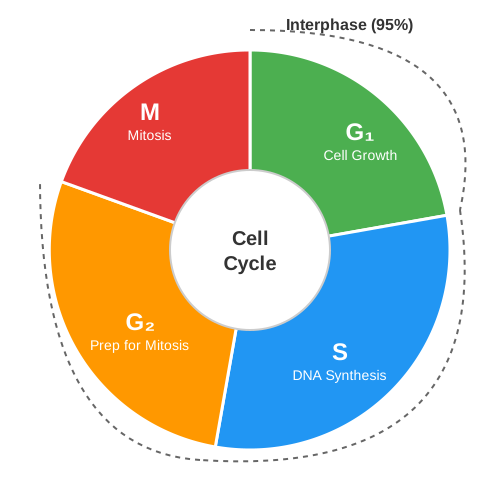
Figure 10.1: A diagrammatic view of the cell cycle
M Phase (Mitosis)
Mitosis, or equational division, is divided into four stages of nuclear division (karyokinesis):
- Prophase: Chromosomal material condenses to form compact mitotic chromosomes. Centrosomes move to opposite poles of the cell. Nuclear envelope breaks down.
- Metaphase: Chromosomes align at the equator of the cell to form the metaphase plate. Spindle fibres attach to kinetochores of chromosomes.
- Anaphase: Centromeres split and chromatids separate. Chromatids move to opposite poles.
- Telophase: Chromosomes cluster at opposite spindle poles and their identity is lost as discrete elements. Nuclear envelope assembles around the chromosome clusters.
Meiosis
The production of offspring by sexual reproduction includes the fusion of two gametes, each with a complete haploid set of chromosomes. Gametes are formed from specialised diploid cells. This specialised kind of cell division that reduces the chromosome number by half results in the production of haploid daughter cells. This kind of division is called meiosis.
Key features of meiosis:
- Involves two sequential cycles of nuclear and cell division called Meiosis I and Meiosis II but only a single cycle of DNA replication.
- It involves pairing of homologous chromosomes and recombination (crossing over) between non-sister chromatids of homologous chromosomes during Prophase I (specifically Pachytene stage).
- Four haploid cells are formed at the end of Meiosis II.
Competency Based Questions (Previous Years & Sample Papers)
Q1. A eukaryotic cell with a diploid chromosome number of $2n = 16$ undergoes the cell cycle. Let the DNA content of a single haploid genome be representing as $C$. Trace the theoretical mathematical number of chromosomes and the DNA content of the cell at the following specific stages: a) End of $G_1$ phase, b) End of $S$ phase, c) Metaphase of Mitosis, d) Anaphase of Mitosis (per entirely dividing cell), and e) Each daughter cell after Cytokinesis is complete.
Answer
Let’s trace the mathematically defined state of the cell based on $2n = 16$ and haploid genome content $= C$:
- The $G_1$ cell starts with diploid chromosomes ($2n$) and a DNA content of $2C$ (as it receives $1C$ from egg and $1C$ from sperm).
a) End of $G_1$ phase:
- Chromosomes: $2n = \mathbf{16}$
- DNA content: $\mathbf{2C}$
b) End of $S$ phase:
- Chromosomes: $2n = \mathbf{16}$ (The number of chromosomes does NOT change; they just consist of two sister chromatids each now).
- DNA content: $\mathbf{4C}$ (DNA has replicated).
c) Metaphase of Mitosis:
- Chromosomes: $2n = \mathbf{16}$ (Aligned at the equator).
- DNA content: $\mathbf{4C}$
d) Anaphase of Mitosis (entire cell):
- Chromosomes: $\mathbf{32}$ (When centromeres split, each sister chromatid is temporarily considered an independent, full-fledged chromosome pulling to opposite poles within the same undivided cell membrane).
- DNA content: $\mathbf{4C}$
e) Each daughter cell after Cytokinesis:
- Chromosomes: $2n = \mathbf{16}$ (One chromatid from anaphase became one chromosome).
- DNA content: $\mathbf{2C}$ (The $4C$ pool was divided equally back to the original $G_1$ state).
Q2. During Prophase I of meiosis, the phenomenon of crossing over occurs between non-sister chromatids of homologous chromosomes. Biologically, what is the primary evolutionary advantage of this process? Mathematically, if a cell possesses $n$ pairs of homologous chromosomes, how does the combination of random assortment at metaphase I and crossing over impact the geometric number of possible unique gametes from a single individual, compared to the baseline $2^n$ combinations without crossing over?
Answer
Evolutionary Advantage: The primary evolutionary advantage of crossing over is the generation of immense genetic variation. By physically breaking and exchanging DNA segments between maternal and paternal chromosomes, entirely new combinations of alleles (recombinant chromosomes) are created that did not exist in either parent. This genetic diversity within a population is crucial for adaptation and survival under changing environmental pressures, conferring the main benefit of sexual reproduction.
Mathematical Impact: Without crossing over, the independent assortment of chromosomes at metaphase I allows for $2^n$ unique chromosome combinations in gametes (where $n$ is the haploid number). For humans ($n=23$), this is $2^{23} \approx 8.4$ million unique gametes. However, because crossing over shuffles alleles within the chromosomes prior to assortment, it essentially creates infinite novel chromosomes. Therefore, crossing over multiplies the $2^n$ baseline geometry into a virtually infinite mathematical number of possible unique gamete combinations. It breaks the mathematical limit imposed by just sorting whole, intact chromosomes.
Q3. Anticancer drugs often work by disrupting specific phases of the cell cycle in rapidly dividing cancer cells. Drug A is a structural analog of thymidine. Drug B binds tightly to tubulin dimers, preventing microtubule assembly. Identify the exact phase of the cell cycle that each drug will specifically arrest, and explain the mechanistic reason why.
Answer
Drug A (Thymidine analog):
- Arrest Phase: It will arrest the cell cycle exclusively in the $S$ phase.
- Reasoning: The $S$ phase is the only phase where DNA replication occurs. To synthesize new DNA, the cell requires massive quantities of the four nucleotide bases, including Thymidine. If a structural analog of Thymidine is present, DNA polymerase will incorporate the fake molecule into the growing DNA strand, causing DNA synthesis to halt (chain termination) or critically fail, triggering a checkpoint arrest or apoptosis during the $S$ phase.
Drug B (Tubulin binder):
- Arrest Phase: It will arrest the cell cycle in M phase, specifically at Metaphase.
- Reasoning: Microtubules are biological polymers formed from tubulin dimers. They are the essential structural components of the mitotic spindle fibres. In Metaphase, the spindle fibres must attach to the kinetochores to pull chromosomes apart in Anaphase. If Drug B prevents microtubule assembly, the mitotic spindle cannot form. The cell will arrest at the spindle assembly checkpoint (M checkpoint) in metaphase because it cannot proceed to separate the chromatids.