Chapter 2: Human Reproduction
Introduction
Humans are sexually reproducing and viviparous. The reproductive events in humans include formation of gametes (gametogenesis), i.e., sperms in males and ovum in females, transfer of sperms into the female genital tract (insemination), and fusion of male and female gametes (fertilisation) leading to formation of zygote. This is followed by development of blastocyst and its attachment to the uterine wall (implantation), embryonic development (gestation), and delivery of the baby (parturition).
The Male Reproductive System
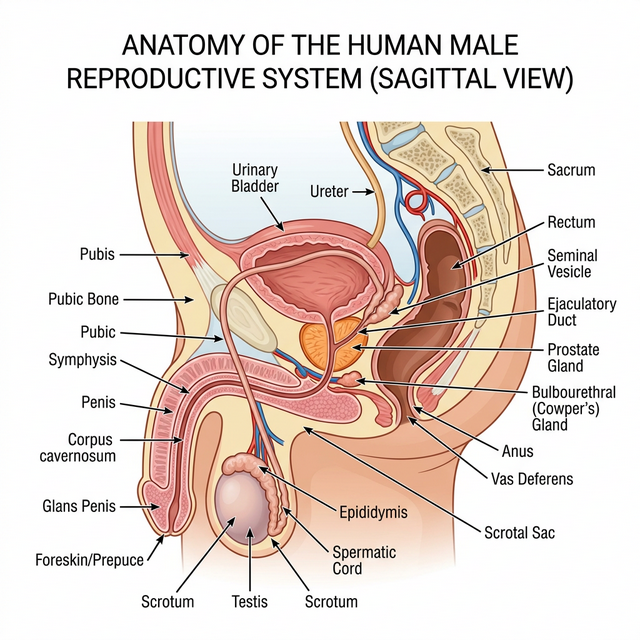
The male reproductive system is located in the pelvis region. It includes a pair of testes along with accessory ducts, glands, and the external genitalia. The testes are situated outside the abdominal cavity within a pouch called scrotum. The scrotum helps in maintaining the low temperature of the testes (2–2.5°C lower than the normal internal body temperature) necessary for spermatogenesis.
Each testis has about 250 compartments called testicular lobules. Each lobule contains 1 to 3 highly coiled seminiferous tubules in which sperms are produced.

The Female Reproductive System
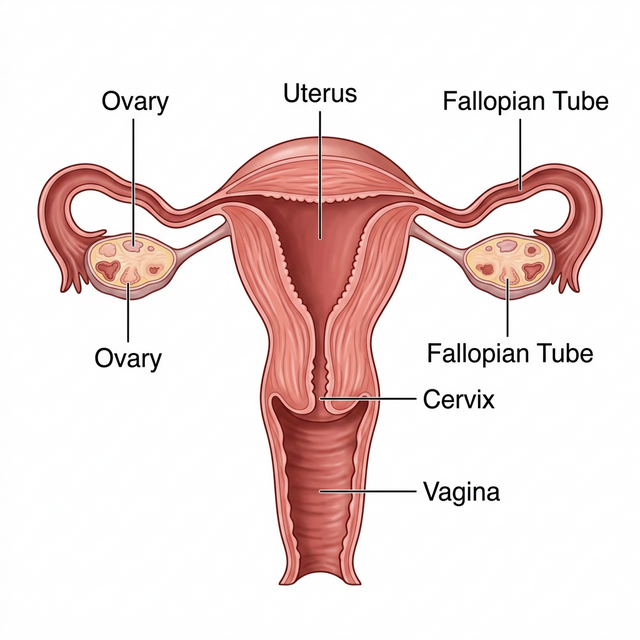
The female reproductive system consists of a pair of ovaries along with a pair of oviducts (fallopian tubes), uterus, cervix, vagina, and the external genitalia located in pelvic region. Ovaries are the primary female sex organs that produce the female gamete (ovum) and several steroid hormones (ovarian hormones).
The oviducts, uterus, and vagina constitute the female accessory ducts. Each fallopian tube is about 10-12 cm long and extends from the periphery of each ovary to the uterus. The part closer to the ovary is the funnel-shaped infundibulum.
Gametogenesis
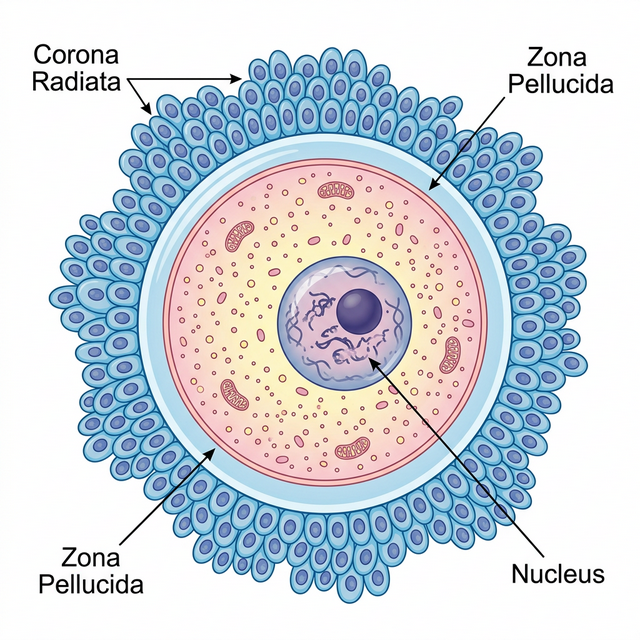
The primary sex organs – the testis in the males and the ovaries in the females – produce gametes, i.e., sperms and ovum, respectively, by the process called gametogenesis.
- Spermatogenesis: In testis, the immature male germ cells (spermatogonia) produce sperms by spermatogenesis that begins at puberty.
- Oogenesis: The process of formation of a mature female gamete is called oogenesis, which is markedly different from spermatogenesis. Oogenesis is initiated during the embryonic development stage.
Menstrual Cycle
The reproductive cycle in the female primates (e.g., monkeys, apes, and human beings) is called menstrual cycle. The cycle starts with the menstrual phase, followed by the follicular phase (proliferative phase), ovulatory phase, and the luteal phase (secretory phase). Ovulation (release of ovum) occurs during the ovulatory phase, usually around the 14th day of a 28-day cycle, driven by the surge of Luteinizing Hormone (LH).
Fertilisation and Implantation
During copulation (coitus), semen is released by the penis into the vagina (insemination). The motile sperms swim rapidly, pass through the cervix, enter into the uterus, and finally reach the ampullary region of the fallopian tube. The ovum released by the ovary is also transported to the ampullary region where fertilisation takes place.
The process of fusion of a sperm with an ovum is called fertilisation. The mitotic division starts as the zygote moves through the isthmus of the oviduct towards the uterus and forms 2, 4, 8, 16 daughter cells called blastomeres. The embryo with 8 to 16 blastomeres is called a morula. The morula continues to divide and transforms into a blastocyst.
The blastomeres in the blastocyst are arranged into an outer layer called trophoblast and an inner group of cells attached to trophoblast called the inner cell mass. The trophoblast layer then gets attached to the endometrium, leading to implantation, which leads to pregnancy.
Pregnancy and Embryonic Development
After implantation, finger-like projections appear on the trophoblast called chorionic villi. The chorionic villi and uterine tissue become interdigitated with each other and jointly form a structural and functional unit between developing embryo (foetus) and maternal body called placenta.
Parturition and Lactation
The average duration of human pregnancy is about 9 months, which is called the gestation period. Vigorous contraction of the uterus at the end of pregnancy causes expulsion/delivery of the foetus. This process of delivery of the foetus is called parturition. The mammary glands of the female undergo differentiation during pregnancy and start producing milk towards the end of pregnancy by the process called lactation.
Competency Based Questions
Q1. A man has a body temperature of 37°C. For healthy spermatogenesis, the temperature of his testes must be maintained at approximately:
(A) 34.5°C to 35°C
(B) 37°C to 37.5°C
(C) 38.5°C to 39°C
(D) 32°C to 32.5°C
Answer and Explanation
Answer: (A) 34.5°C to 35°CExplanation:
The scrotum helps in maintaining the low temperature of the testes, which is 2–2.5°C lower than the normal internal body temperature.
Calculation:
$$ \text{Normal Body Temp } = 37°\text{C} $$
$$ \text{Required Temp for Testes } = 37 - 2 = 35°\text{C} $$
$$ \text{Required Temp for Testes } = 37 - 2.5 = 34.5°\text{C} $$
Thus, the temperature is maintained around 34.5°C to 35.0°C.
Q2. During spermatogenesis, a primary spermatocyte undergoes meiosis I to form secondary spermatocytes, which then undergo meiosis II. If a human primary spermatocyte contains 46 chromosomes and a DNA content of 4C, what will be the chromosome number (n) and DNA content (C) of a spermatid?
(A) 23 chromosomes, 2C DNA
(B) 46 chromosomes, 2C DNA
(C) 23 chromosomes, 1C DNA
(D) 46 chromosomes, 4C DNA
Answer and Explanation
Answer: (C) 23 chromosomes, 1C DNAExplanation:
A primary spermatocyte is diploid and its DNA has duplicated before meiosis I (2n = 46, DNA = 4C).
After Meiosis I, homologous chromosomes separate. The secondary spermatocytes are haploid but have duplicated chromatids (n = 23, DNA = 2C).
After Meiosis II, sister chromatids separate. The resulting spermatids are haploid with un-duplicated chromatids (n = 23, DNA = 1C).
Q3. If a woman’s menstrual cycle is consistently 32 days long, on which approximate day does ovulation most likely occur?
Answer and Explanation
Answer: Day 18Explanation:
The luteal (secretory) phase of the menstrual cycle is relatively constant across most women, typically lasting about 14 days from ovulation to the onset of the next menstruation.
To find the day of ovulation in a 32-day cycle:
$$ \text{Day of Ovulation} = \text{Length of Cycle} - \text{Length of Luteal Phase} $$
$$ \text{Day of Ovulation} = 32 - 14 = 18 $$
Ovulation most likely occurs on or around Day 18.
Q4. A couple is facing infertility issues due to very low sperm motility (asthenozoospermia). Explain why normal sperm motility is essential for fertilization.
Answer and Explanation
Answer: Normal motility is required to reach the ampullary region of the fallopian tube.Explanation:
Fertilization occurs in the ampullary region of the fallopian tube. Upon insemination, the sperms are deposited in the vagina. They must actively swim through the cervix, traverse the entire length of the uterus, and finally reach the fallopian tube. Without vigorous motility provided by the sperm’s tail (flagellum) powered by mitochondria in its middle piece, the sperms cannot reach the ovum in time, resulting in failed fertilization.
Q5. The hormone hCG (human chorionic gonadotropin) is often detected in pregnancy tests. What is its source and primary function in early pregnancy?
Answer and Explanation
Answer: Source: Placenta (Trophoblast cells). Function: Maintains Corpus Luteum.Explanation:
After implantation, the trophoblast cells (which later form part of the placenta) start secreting hCG.
The primary function of hCG is to mimic LH and rescue the corpus luteum from degenerating. The corpus luteum then continues to secrete progesterone, which is essential to maintain the inner lining of the uterus (endometrium), thus supporting the pregnancy.