Chapter 2: Children and Women in Sports
Physical education profoundly affects special populations such as growing children and women. This chapter covers physical fitness development stages, common postural deformities, and the unique conditions female athletes face in sports.
1. WHO Exercise Guidelines for Different Age Groups
The World Health Organization (WHO) provides age-based recommendations for physical activity:
- Infants (< 1 year): Playful, interactive physical activities multiple times a day. Tummy time (at least 30 minutes) spread throughout the day.
- Children (1–4 years): At least 180 minutes of varying types of physical activities. Restricting sedentary screen time.
- Children and Adolescents (5–17 years): Minimum of 60 minutes of moderate-to-vigorous physical activity daily. Bone and muscle strengthening activities at least 3 days a week.
2. Common Postural Deformities and Corrective Measures
Postural deformities refer to exaggerated deviations from normal body alignment.
- Kyphosis: Abnormal backward curvature of the thoracic spine (hunchback).
- Corrective Measures: Chakrasana, Bhujangasana, sitting back against a chair straight.
- Lordosis: Inward curvature of the lumbar spine.
- Corrective Measures: Halasana, Paschimottanasana.
- Scoliosis: Sideways/lateral curvature of the spine.
- Corrective Measures: Hanging on horizontal bars sideways, Trikonasana.
- Knock Knees (Genu Valgum): Knees touch while walking or standing, but heels stay apart.
- Corrective Measures: Padmasana, horseback riding, keeping a pillow between the knees while sleeping.
- Bow Legs (Genu Varum): Outward bending of legs at the knees.
- Corrective Measures: Walking on the inner edge of feet, Garudasana.
- Flat Foot: Absence of the longitudinal arch of the foot.
- Corrective Measures: Walking on toes/heels, picking up marbles with toes.
- Round Shoulders: Shoulders are bent forward.
- Corrective Measures: Hanging on Roman rings, standing in a corner and pressing the chest forward.
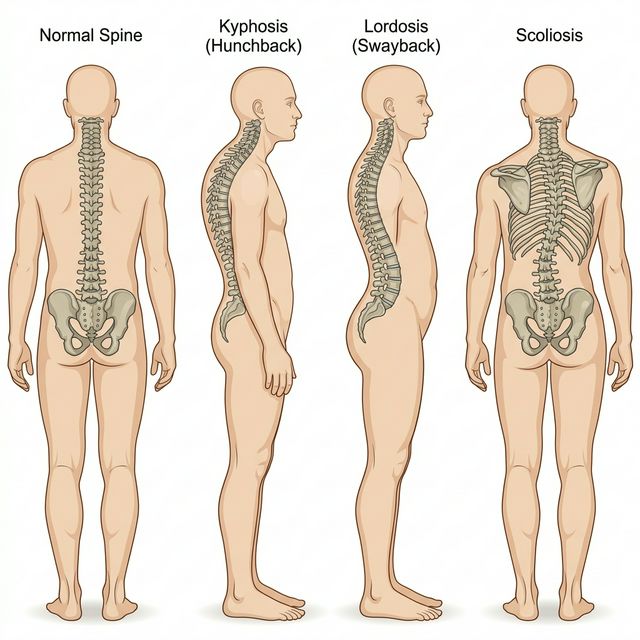
(Left to Right: Normal Spine, Kyphosis, Lordosis, Scoliosis. Image: AI Generated)
3. Women’s Participation in Sports
Historically, women have faced barriers to sports participation. Encouraging it yields tremendous benefits:
- Physical Benefits: Better cardiovascular health, strong bone density.
- Psychological Benefits: Self-esteem, stress release, and body positivity.
- Social Benefits: Teamwork, leadership skills, and dismantling gender stereotypes.
4. Special Considerations for Women
Female athletes face unique biological considerations:
- Menarche: The first occurrence of a menstrual cycle. Late menarche can sometimes be observed in athletes due to stress and intense physical activity.
- Menstrual Dysfunction: Irregularities, skipped periods, or complete cessation of periods due to intense physical training (Amenorrhea).
5. Female Athlete Triad
The Female Athlete Triad is a syndrome of three interrelated conditions often seen in physically active women:
- Eating Disorders: Ranging from anorexia to bulimia, often driven by body image issues in aesthetic sports.
- Amenorrhea: Absence of menstrual periods for three or more consecutive months due to low energy availability.
- Osteoporosis: Weakening of bones due to lack of estrogen (which is affected by amenorrhea) and inadequate calcium/vitamin D intake.
Competency-Based Questions
Q1. An adolescent gymnast is diagnosed with a postural deformity where her lumbar spine curves excessively inward. Based on biometric evaluations, this causes her severe back pain during routines.
a) Identify the postural deformity the gymnast is suffering from.
b) If the force exerted on the lower back is modeled as \( F = m \cdot g \cdot \sin(\theta) \), where \( \theta \) is the angle of the lumbar curve, explain conceptually how increasing the curvature angle affects the shear force on her spine.
Answer: a) The deformity is Lordosis, which is the excessive inward curvature of the lower (lumbar) back.
b) As the angle of the lumbar curve (\( \theta \)) increases, the value of \( \sin(\theta) \) also increases (for angles between 0 and 90 degrees). According to the formula \[ F = m \cdot g \cdot \sin(\theta) \], the shear force \( F \) is directly proportional to \( \sin(\theta) \). Therefore, an excessive inward curve mathematically increases the downward shear force tearing across the vertebrae, leading to severe back pain.
Q2. Case Study: Female Athlete Health Aditi is a long-distance runner. Over the past 6 months, she has restricted her food intake to drop weight, has not had her menstrual period for the last 4 months, and recently suffered a stress fracture in her tibia.
Identify the syndrome Aditi is suffering from and name its three components based on her symptoms.
Answer: Aditi is suffering from the Female Athlete Triad. The three components shown are:
- Eating Disorder (restricted food intake).
- Amenorrhea (absence of periods for 4 months).
- Osteoporosis / Decreased Bone Mineral Density (resulting in the stress fracture).