Chapter 4: Physical Education & Sports for (CWSN)
Children with Special Needs (CWSN) or Divyang deserve equal opportunities in sports and physical education. Adaptive physical education modifies traditional sports rules, equipment, and environments to cater to the differing physical and cognitive abilities of CWSN.
1. Organizations promoting Adaptive Sports
Several international and national bodies work vigorously to promote sports for individuals with disabilities:
Special Olympics
- Focus: Individuals with intellectual disabilities.
- Goal: To provide year-round sports training and athletic competition.
- Special Olympics Bharat: The Indian chapter of the Special Olympics recognized by the Ministry of Youth Affairs and Sports.
Paralympics
- Focus: Athletes with a wide range of physical disabilities (e.g., impaired muscle power, impaired passive range of movement, loss of a limb, visual impairment).
- History: Began in Rome in 1960. Always held alongside the Olympic Games.
- Governing Body: International Paralympic Committee (IPC).
Deaflympics
- Focus: Elite, deaf athletes.
- Characteristics: Athletes must have a hearing loss of at least 55 decibels in their “better ear”. Starters don’t use guns or whistles; instead, they use flags or visual cues.
2. Advantages of Physical Activities for children with special needs
The benefits of active participation are immense and go beyond mere physical fitness:
- Physical Growth: Improved muscular strength, endurance, and cardiovascular efficiency. Enhanced motor skills and coordination.
- Mental Health: Significant reduction in anxiety, stress, and depressive symptoms. Promotes a feeling of self-efficacy.
- Social Development: Provides an avenue to interact with peers, make friends, and learn teamwork.
- Behavioral Improvement: Helps channelize surplus energy positively, reducing aggressive or antisocial behaviors.
3. Strategies to make Physical Activities accessible for CWSN
Creating an inclusive environment requires careful planning and modification:
- Medical Checkup First: Always assess the specific physical boundaries and medical condition of the child before planning activities.
- Modified Equipment: Using lighter balls, brightly colored objects, or balls with bells inside for the visually impaired.
- Adapted Environment: Non-slip surfaces, wider boundaries, sensory-friendly lighting, and wheelchair-accessible courts.
- Simplified Rules: Reducing the complexity of the game rules, allowing more chances, or modifying the scoring system.
- Specialized Instruction: Using visual aids, tactile guidance, sign language, and step-by-step demonstrations.
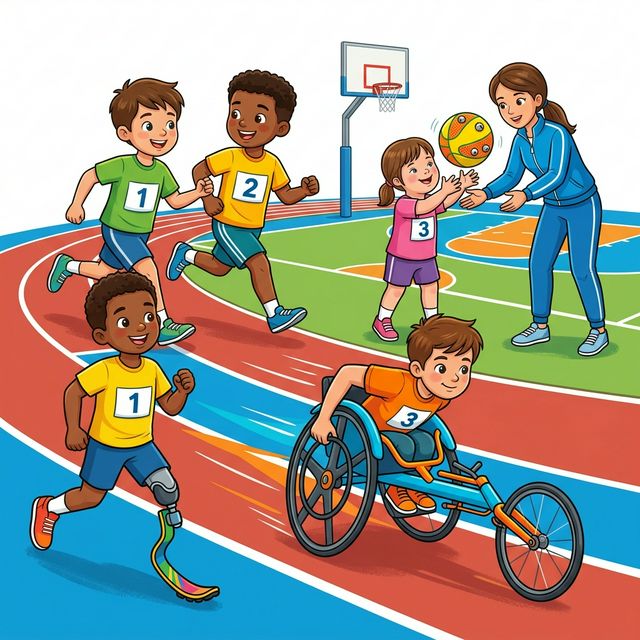
(Inclusive physically active setup for Children with Special Needs. Image: AI Generated)
Competency-Based Questions
Q1. A physical education teacher in a high school wants to introduce sports for two newly admitted students. Student A is legally deaf and uses sign language. Student B has a severe intellectual disability but loves running.
a) Identify the international sporting events specifically designed for the conditions of Student A and Student B, respectively.
b) Calculate the probability \( P(x) \) of both students finding a specialized local coach if the probability of finding a Deaflympics coach \( P(A) = 0.3 \), and a Special Olympics coach \( P(B) = 0.5 \), assuming both events are independent. Use the formula \[ P(A \cap B) = P(A) \times P(B) \].
Answer: a) For Student A (deaf), the corresponding international event is the Deaflympics. For Student B (intellectual disability), the corresponding event is the Special Olympics.
b) \[ P(A \cap B) = P(A) \times P(B) \] \[ P(A \cap B) = 0.3 \times 0.5 = 0.15 \] There is a 15% probability of finding local specialized coaches for both adaptive sports simultaneously.
Q2. Case Study: Modifying an Environment During a basketball session designed for visually impaired students, the instructor notices that the students are frequently colliding and unable to locate the ball efficiently. Suggest three specific strategies the instructor can immediately implement to make the physical activity accessible and safer.
Answer:
- Auditory Equipment: Introduce a basketball with small bells inside so students can track its motion via sound.
- Tactile Boundaries: Place textured tape (like rough sandpaper or raised rubber strips) along the court boundaries so players can feel with their feet when they are stepping out of bounds.
- Auditory Cues at the Hoop: Place a beeper or have a volunteer continuously clap exactly behind the basketball backboard to give players a directional sense of where to shoot.