Chapter 7: Physiology & Injuries in Sport
Physiology studies how the human body functions during exercise and athletic performance. Understanding physiological factors helps in maximizing fitness and swiftly dealing with sports injuries.
1. Physiological Factors Determining Physical Fitness
Physical fitness components are primarily dictated by intrinsic physiological variables:
- Strength: Determined by muscle size, muscle fiber type (fast-twitch vs. slow-twitch), and neural nerve impulses.
- Speed: Depends heavily on the percentage of fast-twitch (white) muscle fibers, mobility of the nervous system, and ATP-CP energy stores.
- Endurance: Relies on maximal oxygen uptake (\( VO_2 \text{ max} \)), lung capacity, stroke volume (cardiac output), and muscle glycogen storage.
- Flexibility: Dictated by joint structure, muscle elasticity, ligaments, and the body’s internal temperature.
2. Effect of Exercise on the Muscular System
Prolonged and systematic exercise induces significant morphological and functional changes in muscles:
- Hypertrophy: Enlargement of muscle fibers, adding strength and mass.
- Capillarization: Increase in the number of capillaries feeding muscle fibers, drastically improving fatigue resistance.
- Lactic Acid Tolerance: Athletes develop a higher threshold for lactic acid accumulation, delaying the onset of muscle fatigue.
3. Effect of Exercise on the Cardio-Respiratory System
- Bradycardia: A lower resting heart rate due to profound efficiency of the cardiac muscle.
- Increased Stroke Volume: The heart pumps more blood per beat. \[ \text{Cardiac Output (Q)} = \text{Stroke Volume (SV)} \times \text{Heart Rate (HR)} \]
- Increased Tidal Volume: The amount of air inhaled/exhaled per breath increases significantly.
- Faster Recovery Rate: The heart rate returns to normal much quicker post-exercise.
4. Sports Injuries: Classification and Management
Injuries are inevitable in competitive sports. They are broadly classified into Soft Tissue Injuries, Bone Injuries, and Joint Injuries.
Soft Tissue Injuries
Injuries affecting muscles, tendons, ligaments, skin, and fat.
- Abrasion: Superficial scraping of the skin against a rough surface.
- Contusion: Bruising caused by a direct blow, crushing underlying muscle fibers without breaking the skin.
- Laceration: An irregular, jagged tear of the skin.
- Incision: A clean, straight cut caused by a sharp edge.
- Sprain: Tearing or overstretching of ligaments (bone to bone). Often occurs at the ankle or wrist.
- Strain: Tearing or overstretching of a muscle or tendon (muscle to bone).
Bone and Joint Injuries
- Dislocation: Displacement of articulating bones from their normal joint position (e.g., shoulder dislocation).
- Fractures: Break in the continuity of a bone.
- Greenstick: Incomplete fracture where the bone bends and cracks (common in children).
- Comminuted: Bone shatters into three or more pieces.
- Transverse / Oblique: Break occurs linearly straight across or at a diagonal angle, respectively.
- Impacted: The broken ends of the bone are jammed into each other.
- Stress Fracture: Tiny hairline cracks caused by repetitive stress or overuse.
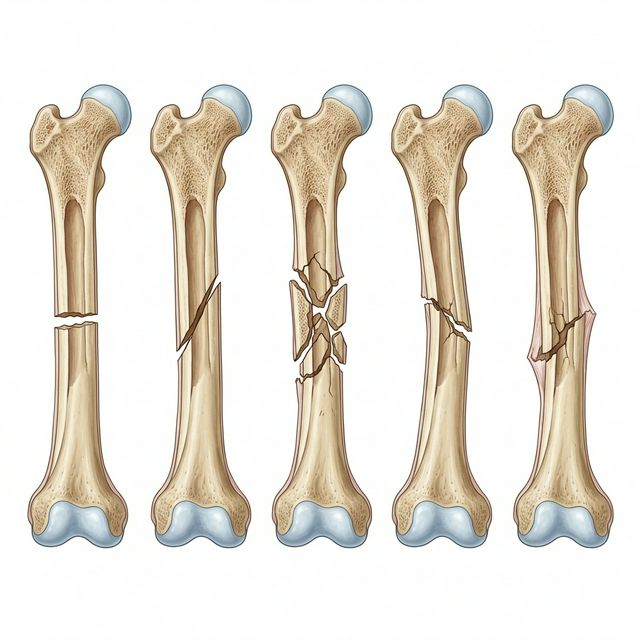
(Left to Right: Transverse, Oblique, Comminuted, Greenstick, Impacted. Image: AI Generated)
Competency-Based Questions
Q1. An Olympic sprinter is praised for her explosive energy off the starting block. A physiologist attributes this primarily to her muscle fiber composition.
a) What specific type of muscle fiber is predominantly responsible for explosive speed and power?
b) If the force generated by a single fast-twitch muscle fiber is \( F_f = 0.5 \text{N} \) and a slow-twitch fiber is \( F_s = 0.2 \text{N} \), calculate the total maximal force \( F_{\text{total}} \) output of a motor unit containing 300 fast-twitch fibers and 100 slow-twitch fibers.
Answer: a) Fast-twitch (White) muscle fibers are predominantly responsible for explosive speed and burst activities because they utilize an anaerobic energy system and contract extremely rapidly.
b) \[ F_{\text{total}} = (300 \times F_f) + (100 \times F_s) \] \[ F_{\text{total}} = (300 \times 0.5) + (100 \times 0.2) \] \[ F_{\text{total}} = 150 \text{N} + 20 \text{N} = 170 \text{N} \] The maximum force output of that specific motor unit is 170 Newtons.
Q2. During a grueling rugby match, Player A lands awkwardly and twists his ankle violently. He hears a ‘pop’ and feels sudden, excruciating pain on the outer side of his ankle.
a) Differentiate scientifically between a Sprain and a Strain.
b) Which specific injury did Player A suffer, and why?
Answer: a) A Sprain is the profound overstretching or tearing of a ligament (the connective tissue connecting bone to bone at a joint). A Strain is the overstretching or tearing of a muscle or tendon (the connective tissue connecting muscle to bone).
b) Player A suffered a Sprain (specifically an inversion ankle sprain). The awkward twisting of joints (like the ankle) stretches the ligaments supporting the talus and fibula bones beyond their elastic limit, culminating in a tear (“pop”).