Chapter 1: Electric Charges and Fields
1.1 Electric Charges and Conservation
Historically, it was observed that rubbing certain materials together caused them to attract lightweight objects. This phenomenon is due to electrification, indicating the presence of electric charge. There are two types of electric charges: positive and negative. Like charges repel and unlike charges attract.
Basic Properties of Electric Charge
- Additivity of charges: If a system contains \(n\) charges \(q_1, q_2, \dots , q_n\), the total charge of the system is \(q_1+q_2 + \dots + q_n\).
- Quantization of charge: Charge on any body is always an integral multiple of a basic unit of charge \(e\). \[q = ne\] where \(n\) is any integer, and \(e \approx 1.6 \times 10^{-19} , \text{C}\).
- Conservation of charge: The total charge of an isolated system remains constant.
1.2 Coulomb’s Law and Superposition Principle
Coulomb’s Law states that the force of attraction or repulsion between two point charges rests is directly proportional to the product of the magnitudes of charges and inversely proportional to the square of the distance between them.
The force magnitude is given by: \[F = k \frac{|q_1 q_2|}{r^2}\] where \(k = \frac{1}{4\pi\varepsilon_0} \approx 9 \times 10^9 , \text{N m}^2/\text{C}^2\), and \(\varepsilon_0\) is the permittivity of free space.
In vector form, the force on \(q_1\) due to \(q_2\) is: \[\vec{F}_{12} = \frac{1}{4\pi\varepsilon_0} \frac{q_1 q_2}{|\vec{r}_{12}|^3} \vec{r}_{12}\]
Superposition Principle
For an assembly of multiple charges \(q_1, q_2, \dots, q_n\), the force on any charge, say \(q_1\), is the vector sum of all the forces on it due to all other charges: \[\vec{F}_1 = \vec{F}_{12} + \vec{F}_{13} + \dots + \vec{F}_{1n}\]
1.3 Electric Field and Field Lines
An electric field is a region around a charged particle within which a force would be exerted on other charged particles. The electric field \(\vec{E}\) at a point is defined as the force \(\vec{F}\) experienced by a small positive test charge \(q_0\) placed at that point, divided by the charge itself: \[\vec{E} = \lim_{q_0 \to 0} \frac{\vec{F}}{q_0}\]
The electric field due to a point charge \(Q\) at distance \(r\) is: \[\vec{E} = \frac{1}{4\pi\varepsilon_0} \frac{Q}{r^2} \hat{r}\]
Electric Field Lines
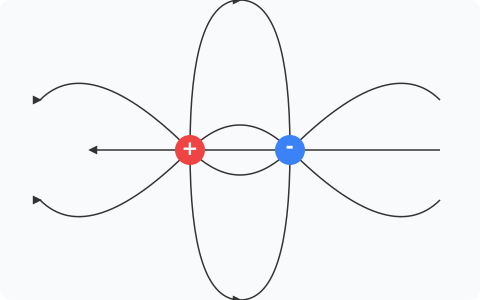
Electric field lines provide a visual representation of the electric field.
- They start from positive charges and end at negative charges.
- The tangent to a field line at any point gives the direction of \(\vec{E}\) at that point.
- Two field lines never cross each other.
Below is the electric field pattern for an electric dipole:
1.4 Electric Dipole
An electric dipole is a pair of equal and opposite point charges \(+q\) and \(-q\), separated by a distance \(2a\). Its dipole moment vector \(\vec{p}\) has magnitude \(p = q \times 2a\) and points from the negative to the positive charge.
Torque on a Dipole in a Uniform Electric Field
When placed in a uniform electric field \(\vec{E}\), the net force on the dipole is zero, but it experiences a torque \(\vec{\tau}\): \[\vec{\tau} = \vec{p} \times \vec{E}\] The magnitude is \(\tau = pE \sin\theta\), where \(\theta\) is the angle between \(\vec{p}\) and \(\vec{E}\).
1.5 Electric Flux and Gauss’s Theorem
Electric Flux (\(\Phi_E\)) through an area element \(\Delta\vec{S}\) is defined as: \[\Delta\Phi_E = \vec{E} \cdot \Delta\vec{S}\] For a closed surface, \(\Phi_E = \oint \vec{E} \cdot d\vec{S}\).
Gauss’s Theorem
Gauss’s law states that the total electric flux through any closed surface is equal to \(\frac{1}{\varepsilon_0}\) times the net charge \(q_{in}\) enclosed by the surface: \[\oint \vec{E} \cdot d\vec{S} = \frac{q_{in}}{\varepsilon_0}\]
Applications of Gauss’s Law
1. Field due to an infinitely long straight charged wire For a wire with uniform linear charge density \(\lambda\), we construct a cylindrical Gaussian surface of radius \(r\) and length \(l\).
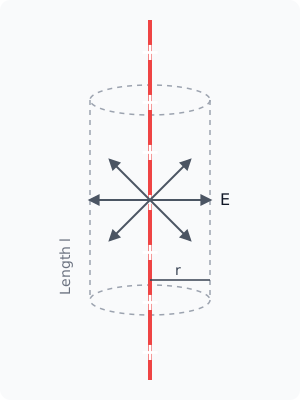
By symmetry, \(\vec{E}\) is radial outward. Flux through the curved surface is \(E(2\pi r l)\). Thus: \[E(2\pi r l) = \frac{\lambda l}{\varepsilon_0} \implies E = \frac{\lambda}{2\pi\varepsilon_0 r}\]
2. Uniformly charged infinite plane sheet For a sheet with surface charge density \(\sigma\), using a cylindrical “pillbox” Gaussian surface: \[2EA = \frac{\sigma A}{\varepsilon_0} \implies E = \frac{\sigma}{2\varepsilon_0}\] Note that \(\vec{E}\) is independent of the distance from the sheet.
3. Uniformly charged thin spherical shell For a shell of radius \(R\) with total charge \(Q\):
- Outside (\(r > R\)): \(E = \frac{1}{4\pi\varepsilon_0} \frac{Q}{r^2}\) (behaves as a point charge)
- Inside (\(r < R\)): \(E = 0\) (since \(q_{in} = 0\))
Competency-Based Questions
Multiple Choice Questions
Q1. [CBSE 2023] A uniformly charged conducting sphere of \(2.4\text{ m}\) diameter has a surface charge density of \(80.0\text{ }\mu\text{C}/\text{m}^2\). What is the total electric flux leaving the surface of the sphere?
(A) \(1.63 \times 10^8 \text{ N m}^2\text{/C}\)
(B) \(3.25 \times 10^8 \text{ N m}^2\text{/C}\)
(C) \(4.01 \times 10^6 \text{ N m}^2\text{/C}\)
(D) \(1.63 \times 10^5 \text{ N m}^2\text{/C}\)
Answer:
Correct Option: (A)
Explanation: Radius \(R = 1.2\text{ m}\). Total charge \(q = 4\pi R^2 \sigma\).
\(q = 4 \times 3.14 \times (1.2)^2 \times 80 \times 10^{-6} = 1.447 \times 10^{-3}\text{ C}\).
By Gauss’s Law, \(\Phi_E = \frac{q}{\varepsilon_0} = \frac{1.447 \times 10^{-3}}{8.85 \times 10^{-12}} \approx 1.63 \times 10^8 \text{ N m}^2\text{/C}\).
Q2. [CBSE Sample Paper 2024] An electric dipole is placed at an angle of \(30^\circ\) with an electric field intensity \(2 \times 10^5 \text{ N/C}\). It experiences a torque equal to \(4\text{ N m}\). The charge on the dipole, if the dipole length is \(2\text{ cm}\), is:
(A) \(8\text{ mC}\)
(B) \(2\text{ mC}\)
(C) \(5\text{ mC}\)
(D) \(7\text{ }\mu\text{C}\)
Answer:
Correct Option: (B)
Explanation: Torque \(\tau = pE\sin\theta = (q \times 2a)E\sin\theta\).
\(4 = q \times (0.02) \times (2 \times 10^5) \times \sin 30^\circ\).
\(4 = q \times 0.02 \times 2 \times 10^5 \times 0.5 \implies q = \frac{4}{2000} = 2 \times 10^{-3}\text{ C} = 2\text{ mC}\).
Assertion-Reasoning Type Questions
Directions: In the following questions, a statement of Assertion (A) is followed by a statement of Reason (R). Choose the correct option: (A) Both A and R are true and R is the correct explanation of A. (B) Both A and R are true but R is NOT the correct explanation of A. (C) A is true but R is false. (D) A is false but R is true.
Q3. [CBSE 2022] Assertion (A): The electric field inside a hollow spherical conductor is strictly zero. Reason (R): Charges always reside on the outer surface of a conductor due to mutual repulsion.
Answer:
Correct Option: (A)
Explanation: Due to mutual repulsion, static charges distribute themselves on the outermost boundary of a conductor such that the field inside remains zero to satisfy electrostatic equilibrium.
Case Study Based Question
Q4. Faraday Cage [CBSE Sample Paper 2024] A Faraday cage or Faraday shield is an enclosure made of a conducting material. The fields within a conductor cancel out with any external fields, so the electric field within the enclosure is zero. These Faraday cages act as big hollow conductors; you can put things in them to shield them from electrical fields.
(i) Which of the following material can be used to make a Faraday cage?
(A) Plastic
(B) Glass
(C) Copper
(D) Wood
Answer:
Correct Option: (C) Copper is a conductor.
(ii) The electric flux through a closed Gaussian surface depends upon:
(A) Net charge enclosed and permittivity of the medium.
(B) Net charge enclosed, permittivity of the medium and the size of the Gaussian surface.
(C) Net charge enclosed only.
(D) Permittivity of the medium only.
Answer:
Correct Option: (A) By Gauss’s Theorem \(\Phi_E = \frac{q_{in}}{\varepsilon}\). It doesn’t depend on the shape or size of the Gaussian surface.