Chapter 1: The Living World
Biology is the story of life on earth. The living world is rich in variety. Millions of plants and animals have been identified and described, but a large number still remains unknown. The very range of organisms in terms of size, colour, habitat, physiological and morphological features makes us seek the defining characteristics of living organisms.
What is Living?
When we try to define ‘living’, we conventionally look for distinctive characteristics exhibited by living organisms. Growth, reproduction, ability to sense environment and mount a suitable response come to our mind immediately as unique features of living organisms. One can add a few more features like metabolism, ability to self-replicate, self-organise, interact and emergence to this list.
Biodiversity
Biodiversity refers to the number and types of organisms present on earth. The number of species that are known and described range between 1.7-1.8 million.
Need for Classification
It is nearly impossible to study all the living organisms. Hence, there is a need to devise some means to make this possible. This process is called classification. Classification is the process by which anything is grouped into convenient categories based on some easily observable characters.
Taxonomy and Systematics
Based on characteristics, all living organisms can be classified into different taxa. This process of classification is taxonomy.
The word systematics is derived from the Latin word ‘systema’ which means systematic arrangement of organisms. Linnaeus used Systema Naturae as the title of his publication. Systematics takes into account evolutionary relationships between organisms.
Three Domains of Life
The three-domain system is a biological classification introduced by Carl Woese in 1990. It divides cellular life forms into archaea, bacteria, and eukaryote domains.
Binomial Nomenclature
The system of providing a name with two components is called Binomial Nomenclature. This naming system given by Carolus Linnaeus is being practised by biologists all over the world. Each name has two components – the Generic name and the specific epithet. Example: The scientific name of mango is written as Mangifera indica. Here Mangifera represents the genus while indica, is a particular species, or a specific epithet.
Rules of Nomenclature:
- Biological names are generally in Latin and written in italics.
- The first word represents the genus while the second component denotes the specific epithet.
- Both the words, when handwritten, are separately underlined, or printed in italics to indicate their Latin origin.
- The first word denoting the genus starts with a capital letter while the specific epithet starts with a small letter.
Concept of Species and Taxonomical Hierarchy
Classification is not a single step process but involves a hierarchy of steps in which each step represents a rank or category. Since the category is a part of overall taxonomic arrangement, it is called the taxonomic category and all categories together constitute the taxonomic hierarchy.
Each category, referred to as a unit of classification, in fact, represents a rank and is commonly termed as taxon (pl.: taxa).
The taxonomic hierarchy:
- Kingdom
- Phylum (or Division for plants)
- Class
- Order
- Family
- Genus
- Species
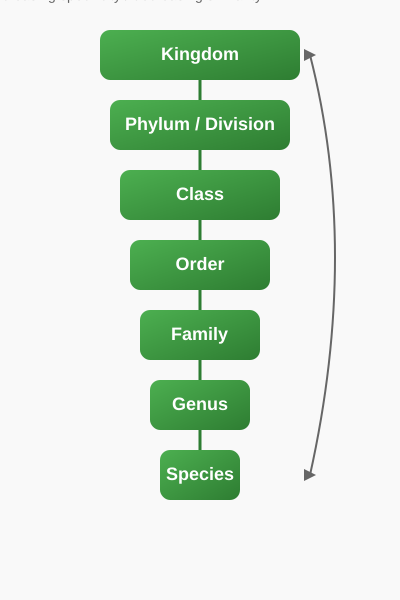
Figure 1.1: Taxonomic Hierarchy
Competency Based Questions (Previous Years & Sample Papers)
Q1. A student found a new organism in a tropical rainforest. The organism has a cell wall but lacks a true nucleus. Based on the three domains of life proposed by Carl Woese, under which domain should this organism be primarily investigated, and why?
Answer
The organism should be investigated under the domain Bacteria or Archaea.
Reasoning: Organisms lacking a true nucleus are prokaryotes. In Carl Woese's three-domain system, all prokaryotes are divided into two domains: Archaea and Bacteria. The domain Eukarya includes all eukaryotes (organisms with a true nucleus). The presence of the cell wall further confirms it is a prokaryote (though some eukaryotes also have cell walls, the lack of a nucleus is the defining prokaryotic feature here).
Q2. Evaluate the following mathematical expression that biologists might use when calculating a biodiversity index (like Simpson’s Diversity Index). Simplify the LaTeX equation:
$$ D = 1 - \sum \left( \frac{n_i}{N} \right)^2 $$
Given a population where type A has \(n_1 = 3\), type B has \(n_2 = 2\), and type C has \(n_3 = 5\). Total population \(N = 10\). Calculate the diversity index \(D\).
Answer
Let us apply the formula:
Step 1: Calculate the probability proportion $P_i = \frac{n_i}{N}$ for each species.
For Type A: $\frac{3}{10} = 0.3$
For Type B: $\frac{2}{10} = 0.2$
For Type C: $\frac{5}{10} = 0.5$
Step 2: Square each proportion:
$(0.3)^2 = 0.09$
$(0.2)^2 = 0.04$
$(0.5)^2 = 0.25$
Step 3: Sum the squared proportions:
$\sum \left( \frac{n_i}{N} \right)^2 = 0.09 + 0.04 + 0.25 = 0.38$
Step 4: Subtract from 1:
$D = 1 - 0.38 = 0.62$
The diversity index $D$ is $0.62$.
Q3. If the number of species in genus A and its related genus B are represented by \(x\) and \(y\) respectively, and their taxonomic relationship is given by the function \(f(x, y) = \frac{\sqrt{x^2 + y^2}}{x \cdot y}\), what happens as the number of species in both genera approaches infinity?
Answer
Let us evaluate the limit as $x \to \infty$ and $y \to \infty$:
$$ \lim_{{x,y \to \infty}} \frac{\sqrt{x^2 + y^2}}{x \cdot y} $$
We can rewrite the expression by bringing $x \cdot y$ inside the square root:
$$ \sqrt{ \frac{x^2 + y^2}{x^2 y^2} } = \sqrt{ \frac{x^2}{x^2 y^2} + \frac{y^2}{x^2 y^2} } = \sqrt{ \frac{1}{y^2} + \frac{1}{x^2} } $$
As $x$ and $y$ approach infinity, both $\frac{1}{x^2}$ and $\frac{1}{y^2}$ approach $0$.
Thus, the limit is $\sqrt{0 + 0} = 0$.
Biologically, this indicates that as the species diversity within individual genera becomes extremely large, the relative mathematical relation $f(x,y)$ between their combined variance and their cross-product diversity diminishes towards zero.