Chapter 2: Biological Classification
Since the dawn of civilisation, there have been many attempts to classify living organisms. It was done instinctively not using criteria that were scientific but borne out of a need to use organisms for our own use – for food, shelter and clothing. Aristotle was the earliest to attempt a more scientific basis for classification. He used simple morphological characters to classify plants into trees, shrubs and herbs. He also divided animals into two groups, those which had red blood and those that did not.
Five Kingdom Classification
In Linnaeus’ time a Two Kingdom system of classification with Plantae and Animalia kingdoms was developed that included all plants and animals respectively. This system did not distinguish between the eukaryotes and prokaryotes, unicellular and multicellular organisms and photosynthetic (green algae) and non-photosynthetic (fungi) organisms.
R.H. Whittaker (1969) proposed a Five Kingdom Classification. The kingdoms defined by him were named Monera, Protista, Fungi, Plantae and Animalia. The main criteria for classification used by him include cell structure, body organisation, mode of nutrition, reproduction and phylogenetic relationships.
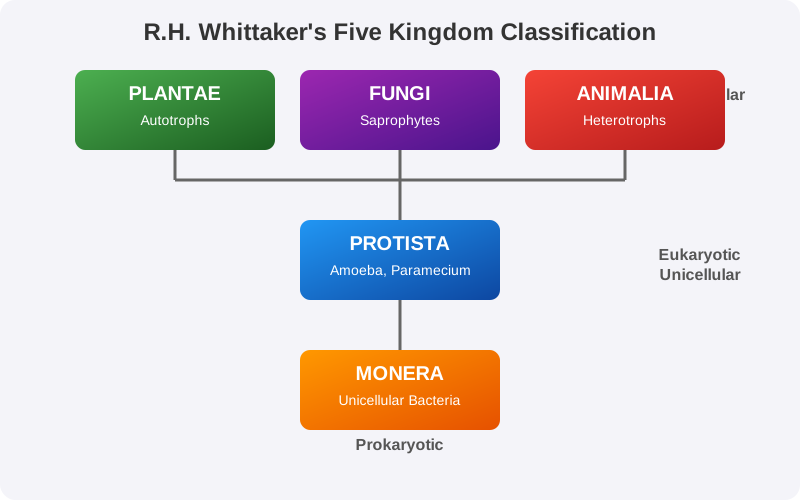
Figure 2.1: R.H. Whittaker's Five Kingdom Classification
Kingdom Monera
Bacteria are the sole members of the Kingdom Monera. They are the most abundant micro-organisms. Bacteria occur almost everywhere. Hundreds of bacteria are present in a handful of soil.
Bacteria are grouped under four categories based on their shape:
- the spherical Coccus (pl.: cocci)
- the rod-shaped Bacillus (pl.: bacilli)
- the comma-shaped Vibrium (pl.: vibrio)
- the spiral Spirillum (pl.: spirilla)
Archaebacteria
These bacteria are special since they live in some of the most harsh habitats such as extreme salty areas (halophiles), hot springs (thermoacidophiles) and marshy areas (methanogens).
Eubacteria
There are thousands of different eubacteria or ‘true bacteria’. They are characterised by the presence of a rigid cell wall, and if motile, a flagellum. The cyanobacteria (also referred to as blue-green algae) have chlorophyll a similar to green plants and are photosynthetic autotrophs.
Kingdom Protista
All single-celled eukaryotes are placed under Protista, but the boundaries of this kingdom are not well defined. What may be ‘a photosynthetic protistan’ to one biologist may be ‘a plant’ to another.
In this group we include:
- Chrysophytes: Includes diatoms and golden algae (desmids).
- Dinoflagellates: These organisms are mostly marine and photosynthetic.
- Euglenoids: Majority of them are fresh water organisms found in stagnant water.
- Slime Moulds: Saprophytic protists.
- Protozoans: All protozoans are heterotrophs and live as predators or parasites.
Kingdom Fungi
The fungi constitute a unique kingdom of heterotrophic organisms. They show a great diversity in morphology and habitat. When your bread develops a mould or your orange rots it is because of fungi.
Features:
- Most fungi are heterotrophic and absorb soluble organic matter from dead substrates and hence are called saprophytes.
- Those that depend on living plants and animals are called parasites.
- They can also live as symbionts – in association with algae as lichens and with roots of higher plants as mycorrhiza.
Viruses, Viroids, Prions and Lichens
In the five-kingdom classification of Whittaker there is no mention of lichens and some acellular organisms like viruses, viroids and prions.
- Viruses: The viruses are non-cellular organisms that are characterised by having an inert crystalline structure outside the living cell. Once they infect a cell they take over the machinery of the host cell to replicate themselves, killing the host.
- Viroids: In 1971, T.O. Diener discovered a new infectious agent that was smaller than viruses and caused potato spindle tuber disease. It was found to be a free RNA; it lacked the protein coat that is found in viruses.
- Prions: In modern medicine certain infectious neurological diseases were found to be transmitted by an agent consisting of abnormally folded protein. These agents are called prions.
- Lichens: Lichens are symbiotic associations i.e. mutually useful associations, between algae and fungi. The algal component is known as phycobiont and fungal component as mycobiont.
Competency Based Questions (Previous Years & Sample Papers)
Q1. Consider the growth of a bacterial population in a conducive environment. The growth can be modeled according to the exponential equation $N\sb{t} = N\sb{0} \cdot 2^n$, where $N\sb{t}$ is the final population, $N\sb{0}$ is the initial population, and $n$ is the number of generations. If a population of E. coli starts with 5 cells and divides every 20 minutes, what will be the population after 3 hours? Calculate the exact value.
Answer
First, let’s identify the given values: Initial population $N\sb{0} = 5$ Division time = 20 minutes Total time = 3 hours = 180 minutes
Step 1: Calculate the number of generations $n$. $n = \frac{180 \text{ minutes}}{20 \text{ minutes/generation}} = 9 \text{ generations}$
Step 2: Apply the exponential growth formula: $N\sb{t} = N\sb{0} \cdot 2^n$ $N\sb{t} = 5 \cdot 2^9$
Step 3: Calculate the power of 2: $2^9 = 512$
Step 4: Final calculation: $N\sb{t} = 5 \cdot 512 = 2560$
The population of E. coli after 3 hours will be 2560 cells.
Q2. During a laboratory experiment, a student isolates an organism that has a well-defined nucleus, is unicellular, and possesses cilia for locomotion. It also shows a contractile vacuole for osmoregulation. Based on R.H. Whittaker’s five-kingdom classification, to which kingdom does this organism belong, and why?
Answer
The organism belongs to Kingdom Protista.
Reasoning:
- Unicellular Eukaryote: The presence of a “well-defined nucleus” indicates that it is a eukaryote. The fact that it is “unicellular” fits perfectly within Kingdom Protista, which Whittaker defined as the kingdom for all single-celled eukaryotes.
- Cilia and Contractile Vacuole: These are characteristic features of ciliated protozoans (like Paramecium), which are a major group within Kingdom Protista.
- It cannot be Monera because it has a true nucleus (Monera members are prokaryotes). It cannot be Fungi, Plantae, or Animalia because those are typically multicellular kingdoms (with a few exceptions like yeast, but yeast do not have cilia or contractile vacuoles).
Q3. Viroids differ from viruses in a fundamental biochemical structural aspect. If the molecular weight of a viroid’s genetic material is $M\sb{v}$ and the molecular weight of a comparable virus is $M\sb{vir}$, the relationship is generally $M\sb{v} < M\sb{vir}$. Explain the biological basis for this inequality based on the composition of viroids.
Answer
The biological basis for the relationship $M\sb{v} < M\sb{vir}$ lies in the structural composition of the two infectious agents:
- Virus Composition: A typical virus consists of genetic material (either DNA or RNA) enclosed within a protein coat called a capsid. Therefore, the total molecular weight of a virus ($M\sb{vir}$) is the sum of the weights of its nucleic acid and its protein coat.
- Viroid Composition: Viroids, discovered by T.O. Diener, are composed solely of free, short strands of naked RNA. They completely lack the protein coat (capsid) that viruses have. Furthermore, the RNA of a viroid is of low molecular weight.
Because a viroid is essentially just a molecule of low-molecular-weight RNA without any associated proteins, its total molecular weight ($M\sb{v}$) will always be significantly less than that of a complete virus particle ($M\sb{vir}$).