Chapter 3: Plant Kingdom
In the previous chapter, we looked at the broad classification of living organisms under the system proposed by Whittaker (1969) wherein he suggested the Five Kingdom classification viz. Monera, Protista, Fungi, Animalia and Plantae. In this chapter, we will deal in detail with further classification within Kingdom Plantae popularly known as the ‘plant kingdom’.
We must stress here that our understanding of the plant kingdom has changed over time. Fungi, and members of the Monera and Protista having cell walls have now been excluded from Plantae though earlier classifications placed them in the same kingdom. The cyanobacteria that are also referred to as blue-green algae are not ‘algae’ any more. In this chapter, we will describe Algae, Bryophytes, Pteridophytes and Gymnosperms under Plantae.
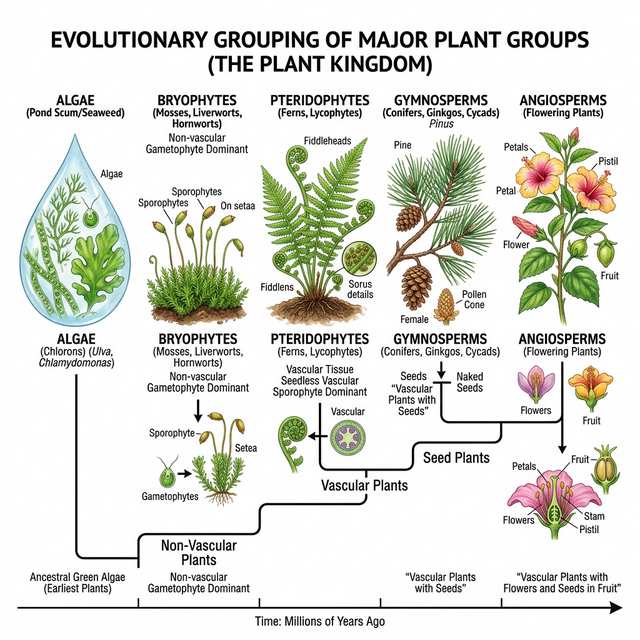
Figure 3.1: Evolutionary grouping of plants
Algae
Algae are chlorophyll-bearing, simple, thalloid, autotrophic and largely aquatic (both fresh water and marine) organisms. They occur in a variety of other habitats: moist stones, soils and wood. Some of them also occur in association with fungi (lichen) and animals (e.g., on sloth bear).
Classes of Algae
- Chlorophyceae (Green algae): The plant body may be unicellular, colonial or filamentous. They are usually grass green due to the dominance of pigments chlorophyll a and b.
- Phaeophyceae (Brown algae): Found primarily in marine habitats. They possess chlorophyll a, c, carotenoids and xanthophylls. They show great variation in size and form.
- Rhodophyceae (Red algae): The members of Rhodophyceae are commonly called red algae because of the predominance of the red pigment, r-phycoerythrin in their body.
Bryophytes
Bryophytes include the various mosses and liverworts that are found commonly growing in moist shaded areas in the hills. Bryophytes are also called amphibians of the plant kingdom because these plants can live in soil but are dependent on water for sexual reproduction. They usually occur in damp, humid and shaded localities.
- Liverworts: Grow usually in moist, shady habitats such as banks of streams, marshy ground, damp soil, bark of trees and deep in the woods.
- Mosses: The predominant stage of the life cycle of a moss is the gametophyte which consists of two stages: protonema and leafy stage. They play an important role in plant succession on bare rocks/soil.
Pteridophytes
The Pteridophytes include horsetails and ferns. Pteridophytes are used for medicinal purposes and as soil-binders. They are also frequently grown as ornamentals. Evolutionarily, they are the first terrestrial plants to possess vascular tissues — xylem and phloem.
The pteridophytes are found in cool, damp, shady places though some may flourish well in sandy-soil conditions. The main plant body is a sporophyte which is differentiated into true root, stem and leaves. The leaves in pteridophyta are small (microphylls) as in Selaginella or large (macrophylls) as in ferns.
Gymnosperms
The gymnosperms (gymnos : naked, sperma : seeds) are plants in which the ovules are not enclosed by any ovary wall and remain exposed, both before and after fertilisation. The seeds that develop post-fertilisation, are not covered, i.e., are naked. Gymnosperms include medium-sized trees or tall trees and shrubs.
One of the gymnosperms, the giant redwood tree Sequoia is one of the tallest tree species. The roots are generally tap roots. Roots in some genera have fungal association in the form of mycorrhiza (Pinus), while in some others (Cycas) small specialised roots called coralloid roots are associated with \text{N}_2- fixing cyanobacteria.
Competency Based Questions (Previous Years & Sample Papers)
Q1. A botanist discovers a new plant species in a damp, shaded forest. The plant is small and lacks true roots, stems, and leaves, but has root-like structures called rhizoids. It also requires a film of water for its sperm to swim to the egg for fertilization. Based on these characteristics, which major plant division does this species most likely belong to, and why? Estimate the ploidy level ($n$ or $2n$) of its main free-living plant body.
Answer
This plant species belongs to the Bryophytes.
Reasoning:
- Lack of true roots, stems, leaves: Unlike pteridophytes, gymnosperms, and angiosperms, bryophytes have a thallus-like body and lack true vascular tissues and organs. They possess root-like structures (rhizoids) instead.
- Water dependence for fertilization: Bryophytes are often called the “amphibians of the plant kingdom” specifically because their biflagellate sperm (antherozoids) require a layer of water to swim to the egg (archegonium) for fertilization.
- Habitat: They are typically found in damp, shaded environments, which aligns with the botanist’s discovery.
Ploidy Level: The main, free-living, photosynthetic plant body of a bryophyte is the gametophyte, which is haploid ($n$). The sporophyte ($2n$) is physically attached to and nutritionally dependent on the gametophyte.
Q2. During a field trip, a student observes two different vascular plants. Plant A has large leaves (fronds) that uncoil as they grow, and produces spores on the undersides of its leaves. Plant B is a large tree with needle-like leaves and bears its seeds in cones, not enclosed in any fruit. Identify the broad groups to which Plant A and Plant B belong. If the number of chromosomes in the endosperm of Plant B is $3x = 36$, what would be the expected mathematical relationship for the ploidy of its endosperm compared to an angiosperm? (Note: Angiosperm endosperm is typically 3n)
Answer
Identification:
- Plant A is a Pteridophyte (specifically a fern). It is a vascular plant that reproduces via spores (often in sori on the underside of macrophylls/fronds) rather than seeds.
- Plant B is a Gymnosperm (like a pine tree). It is a vascular plant that produces “naked” seeds in cones, without a fruit or ovary wall.
Ploidy Relationship: The prompt contains a trick. While the question mentions $3x = 36$ as a hypothetical, in reality, the endosperm of a Gymnosperm is formed before fertilization and represents the female gametophyte tissue. Therefore, the ploidy of a gymnosperm’s endosperm is strictly haploid ($n$).
Assuming the prompt implies comparing an actual gymnosperm to an angiosperm:
- Gymnosperm endosperm = $n$
- Angiosperm endosperm = $3n$ (due to double fertilization)
The mathematical relationship is that the ploidy of the gymnosperm endosperm is one-third ($\frac{1}{3}$) that of an angiosperm endosperm. If the problem explicitly dictates an artificial scenario where Plant B has $3x=36$, it contradicts biological reality for gymnosperms, but mathematically $x = 12$. However, biologically, the gymnosperm tissue is $n$.
Q3. Calculate the surface area to volume ratio ($SA/V$) for a spherical unicellular green alga with a radius $r = 10 \mu m$ and a filamentous green alga modeled as a cylinder of the same radius $r = 10 \mu m$ but length $h = 100 \mu m$. The formulas are: $SA_{sphere} = 4\pi r^2$, $V_{sphere} = \frac{4}{3}\pi r^3$, $SA_{cylinder} = 2\pi r^2 + 2\pi rh$, $V_{cylinder} = \pi r^2 h$. Which shape is more efficient for nutrient absorption from the surrounding water?
Answer
Let’s calculate the ratios for both algae.
For the spherical alga: $SA_{sphere} = 4 \cdot \pi \cdot (10)^2 = 400\pi \mu m^2$ $V_{sphere} = \frac{4}{3} \cdot \pi \cdot (10)^3 = \frac{4000\pi}{3} \mu m^3$
Ratio for sphere: $$ \frac{SA}{V}_{sphere} = \frac{400\pi}{\frac{4000\pi}{3}} = \frac{400 \cdot 3}{4000} = \frac{1200}{4000} = 0.3 \mu m^{-1} $$
For the filamentous (cylindrical) alga: $SA_{cylinder} = 2\pi(10)^2 + 2\pi(10)(100) = 200\pi + 2000\pi = 2200\pi \mu m^2$ $V_{cylinder} = \pi(10)^2(100) = 10000\pi \mu m^3$
Ratio for cylinder: $$ \frac{SA}{V}_{cylinder} = \frac{2200\pi}{10000\pi} = 0.22 \mu m^{-1} $$
Conclusion: Comparing the two ratios ($0.3 > 0.22$), the spherical alga has a higher Surface Area to Volume ratio. Therefore, the spherical shape is more efficient for passive nutrient absorption from the surrounding water per unit of internal volume compared to the thick filament modeled here.