Chapter 4: Animal Kingdom
When you look around, you will observe different animals with different structures and forms. As over a million species of animals have been described till now, the need for classification becomes all the more important. The classification also helps in assigning a systematic position to newly described species.
Basis of Classification
Inspite of differences in structure and form of different animals, there are fundamental features common to various individuals in relation to the arrangement of cells, body symmetry, nature of coelom, patterns of digestive, circulatory or reproductive systems. These features are used as the basis of animal classification.
- Levels of Organisation: Cellular (Porifera), Tissue (Coelenterata, Ctenophora), Organ, and Organ system.
- Symmetry: Asymmetrical, Radial, and Bilateral symmetry.
- Diploblastic and Triploblastic Organisation: Animals with two embryonic layers (ectoderm and endoderm) are diploblastic. Those with three (including mesoderm) are triploblastic.
- Coelom: The presence or absence of a cavity between the body wall and the gut wall is very important in classification.
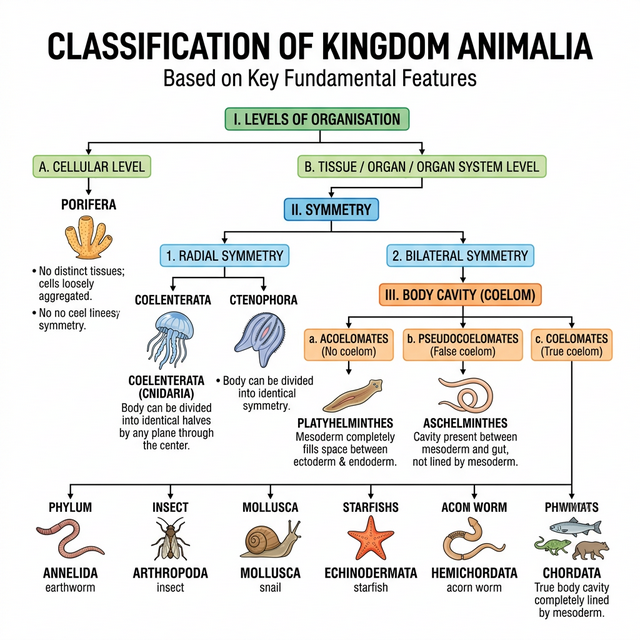
Figure 4.1: Broad classification of Kingdom Animalia based on common fundamental features
Classification of Animals
The broad classification of Animalia based on common fundamental features:
Non-Chordates
- Phylum Porifera: Sponges; cellular level of organisation; asymmetrical. Have a water transport or canal system.
- Phylum Coelenterata (Cnidaria): Aquatic, mostly marine; have cnidoblasts for defense and prey capture; radial symmetry. Examples: Hydra, Aurelia.
- Phylum Ctenophora: Commonly known as sea walnuts or comb jellies; exclusively marine; have 8 external rows of ciliated comb plates. Bioluminescence is well-marked.
- Phylum Platyhelminthes: Flatworms; dorso-ventrally flattened body; bilateral symmetry, triploblastic, acoelomate animals with organ level of organisation. Many are endoparasites.
- Phylum Aschelminthes: Roundworms; the body is circular in cross-section; pseudocoelomate animals.
- Phylum Annelida: Aquatic or terrestrial; their body surface is distinctly marked out into segments or metameres (e.g., Earthworm).
- Phylum Arthropoda: The largest phylum of Animalia which includes insects. They have jointed appendages. The body is covered by a chitinous exoskeleton.
- Phylum Mollusca: The second largest phylum. They have a soft body usually covered by a calcareous shell and an unsegmented body with a distinct head, muscular foot and visceral hump.
- Phylum Echinodermata: Animals with an endoskeleton of calcareous ossicles; adults have radial symmetry but larvae are bilaterally symmetrical. Have a unique water vascular system. Example: Starfish.
- Phylum Hemichordata: Small group of worm-like marine animals. They have a rudimentary structure in the collar region called stomochord, a structure similar to notochord.
Phylum Chordata
Animals belonging to phylum Chordata are fundamentally characterised by the presence of a notochord, a dorsal hollow nerve cord and paired pharyngeal gill slits.
Phylum Chordata is divided into three subphyla: Urochordata or Tunicata, Cephalochordata and Vertebrata.
Subphylum Vertebrata is further divided as follows:
- Agnatha (lacks jaw):
- Class Cyclostomata: Ectoparasites on some fishes; circular mouth without jaws.
- Gnathostomata (bears jaw):
- Super Class Pisces (bear fins):
- Class Chondrichthyes: Cartilaginous fishes (e.g., Sharks).
- Class Osteichthyes: Bony fishes (e.g., Rohu, Seahorse).
- Super Class Tetrapoda (bear limbs):
- Class Amphibia: Can live in aquatic as well as terrestrial habitats.
- Class Reptilia: Creeping or crawling mode of locomotion; dry and cornified skin.
- Class Aves: Birds; presence of feathers and most of them can fly except flightless birds. Forelimbs modified into wings.
- Class Mammalia: Have mammary glands (milk producing glands) to nourish young ones. They have hair on the skin.
- Super Class Pisces (bear fins):
Competency Based Questions (Previous Years & Sample Papers)
Q1. An entomologist collects an unknown animal from the soil. Upon dissection, she finds that it has a bilateral symmetry, a true coelom lined by mesoderm, an open circulatory system, and its body is divided into a head, thorax, and abdomen with jointed appendages. Using the classification system, to which Phylum does this organism belong? Name the specific carbohydrate polymer that likely coats the exterior forming its exoskeleton.
Answer
The organism belongs to Phylum Arthropoda.
Reasoning: While many phyla have bilateral symmetry and a true coelom (such as Annelida and Mollusca), the defining combination here is the jointed appendages and the specific body segmentation into head, thorax, and abdomen, along with an open circulatory system. These are classic, defining hallmarks of arthropods (specifically resembling insects/hexapods).
The specific carbohydrate polymer that forms its exoskeleton is Chitin. Chitin is a rigid, structural polysaccharide found extensively in the exoskeletons of arthropods.
Q2. The transition from an aquatic to a terrestrial lifestyle required several major adaptations in vertebrates. A key adaptation seen in Class Reptilia, Aves, and Mammalia but absent in Class Amphibia is the development of the amniotic egg. If a wildlife biologist observes an unknown vertebrate laying eggs in a dry, sandy environment, and the eggs have a leathery, calcium-based shell, list two Classes to which this animal most likely belongs. Why would an amphibian fail to reproduce in this exact spot?
Answer
The animal most likely belongs to either Class Reptilia or Class Aves.
Reasoning: Both reptiles and birds are amniotes capable of laying shelled eggs in dry, terrestrial environments. The leathery, calcium-based shell prevents desiccation (drying out) while allowing gas exchange.
Why an amphibian would fail: Amphibians (like frogs and salamanders) are not amniotes. They produce eggs without a protective, hard or leathery shell and lack the specialized extraembryonic membranes (like the amnion and chorion). Consequently, amphibian eggs are highly susceptible to desiccation. They must be laid in water or extremely moist environments. If an amphibian were to lay eggs in a dry, sandy environment, the eggs would quickly dry out and perish.
Q3. Consider the allometric scaling of metabolic rate in mammals, which frequently follows Kleiber’s Law: $B \propto M^{3/4}$, where $B$ is the basal metabolic rate and $M$ is the body mass. A biologist compares two mammals: a mouse (mass $m$) and a human (mass $M = 10000m$). Calculate the ratio of the human’s metabolic rate to the mouse’s metabolic rate ($B_{human}/B_{mouse}$). Despite the human being 10,000 times heavier, explain why the ratio is not exactly 10,000.
Answer
Let’s calculate the ratio using Kleiber’s Law: $B = k \cdot M^{3/4}$
For the mouse: $B_{mouse} = k \cdot m^{3/4}$ For the human: $B_{human} = k \cdot (10000m)^{3/4}$
Ratio: $$ \frac{B_{human}}{B_{mouse}} = \frac{k \cdot (10000m)^{3/4}}{k \cdot m^{3/4}} = (10000)^{3/4} $$
To solve $(10000)^{3/4}$: $$ (10000)^{3/4} = (10^4)^{3/4} = 10^{4 \cdot \frac{3}{4}} = 10^3 = 1000 $$
So, the ratio $\frac{B_{human}}{B_{mouse}}$ is $1000$.
Biological Explanation: Even though the human is 10,000 times heavier, their metabolic rate is only 1,000 times greater. The ratio is not 10,000 (which would be a linear 1:1 scaling) because metabolic rate scales allometrically (specifically to the 3/4 power), not isometrically, with mass.
A larger mammal has a relatively smaller surface area-to-volume ratio than a small mammal. Since heat is lost across the body surface, the smaller mammal loses heat much faster relative to its mass and must maintain a significantly higher metabolic rate per gram of tissue to maintain its body temperature (assuming they are both endotherms/Mammalia). Thus, mass-specific metabolic rate decreases as structural size increases.