Chapter 5: Morphology of Flowering Plants
Morphology is the study of the external structure of an organism. The wide range in the structure of higher plants will never fail to fascinate us. Even though the angiosperms show such a large diversity in external structure or morphology, they are all characterised by presence of roots, stems, leaves, flowers and fruits.
In this chapter, we will learn about the possible variations in different parts, found as adaptations of the plants to their environment, e.g., adaptations to various habitats, for protection, climbing, storage, etc.
The Root
In majority of the dicotyledonous plants, the direct elongation of the radicle leads to the formation of primary root which grows inside the soil. It bears lateral roots of several orders that are referred to as secondary, tertiary, etc., roots.
- Tap root system: The primary root and its branches constitute the tap root system, as seen in the mustard plant.
- Fibrous root system: In monocotyledonous plants, the primary root is short-lived and is replaced by a large number of roots originating from the base of the stem. Example: Wheat.
- Adventitious roots: Roots arising from parts of the plant other than the radicle are called adventitious roots (e.g., grass, Monstera and banyan tree).
Regions of the root include the root cap, region of meristematic activity, region of elongation, and region of maturation (with root hairs). Modifications of roots include storage roots (carrot, turnip, sweet potato), prop roots (banyan), stilt roots (maize, sugarcane), and pneumatophores (Rhizophora) for respiration.
The Stem
The stem is the ascending part of the axis bearing branches, leaves, flowers and fruits. It develops from the plumule of the embryo of a germinating seed. The stem bears nodes and internodes.
Stems can be modified to perform different functions:
- Storage: Underground stems of potato, ginger, turmeric.
- Tendrils: Developed from axillary buds, they are slender and spirally coiled to help plants climb (e.g., gourds, grapevines).
- Thorns: Woody, straight and pointed structures protecting plants from browsing animals (e.g., Citrus, Bougainvillea).
The Leaf
The leaf is a lateral, generally flattened structure borne on the stem. It develops at the node and bears a bud in its axil. Leaves originate from shoot apical meristems and are arranged in an acropetal order. They are the most important vegetative organs for photosynthesis.
- Venation: The arrangement of veins and the veinlets in the lamina of leaf is termed as venation (Reticulate in dicots, Parallel in monocots).
- Phyllotaxy: The pattern of arrangement of leaves on the stem or branch (Alternate, Opposite, Whorled).
The Inflorescence
A flower is a modified shoot wherein the shoot apical meristem changes to floral meristem. The arrangement of flowers on the floral axis is termed as inflorescence.
- Racemose: The main axis continues to grow, the flowers are borne laterally in an acropetal succession.
- Cymose: The main axis terminates in a flower, hence is limited in growth. The flowers are borne in a basipetal order.
The Flower
The flower is the reproductive unit in the angiosperms. It is meant for sexual reproduction. A typical flower has four different kinds of whorls arranged successively on the swollen end of the stalk or pedicel, called thalamus or receptacle. These are calyx, corolla, androecium and gynoecium.
Based on the position of calyx, corolla and androecium in respect of the ovary on thalamus, the flowers are described as:
- Hypogynous: Ovary is superior (e.g., mustard).
- Perigynous: Ovary is half inferior (e.g., plum, rose).
- Epigynous: Ovary is inferior (e.g., guava, cucumber).
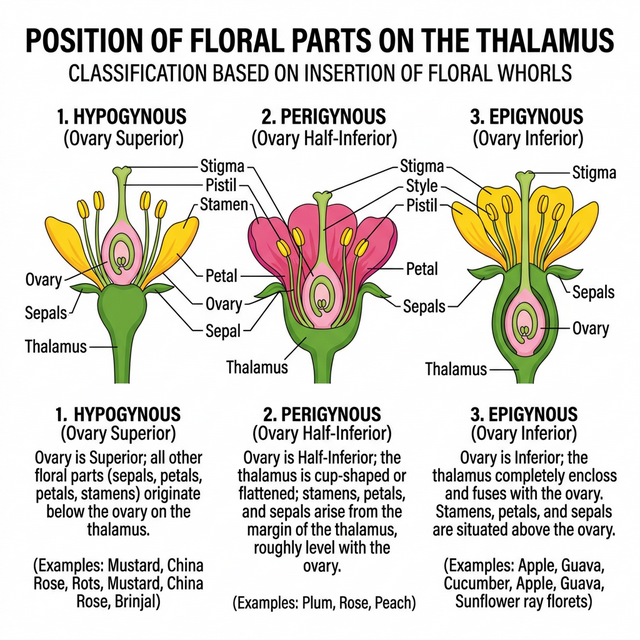
Figure 5.1: Position of floral parts on thalamus
Fruit and Seed
The fruit is a characteristic feature of the flowering plants. It is a mature or ripened ovary, developed after fertilisation. If a fruit is formed without fertilisation of the ovary, it is called a parthenocarpic fruit.
After fertilisation, ovules develop into seeds. A seed is made up of a seed coat and an embryo. The embryo is made up of a radicle, an embryonal axis and one (as in wheat, maize) or two cotyledons (as in gram and pea).
Competency Based Questions (Previous Years & Sample Papers)
Q1. Suppose the initial number of dividing cells in the meristematic region of a growing root is $N_0$. These cells undergo arithmetic growth, where only one daughter cell continues to divide while the other differentiates. If the rate of cell division adds $r$ new differentiating cells per day, express the total number of cells $N_t$ after $t$ days as a mathematical equation. If $N_0 = 100$ and $r = 50$ cells/day, what is the total number of cells after 10 days? Does this equation represent linear or exponential growth?
Answer
Mathematical Equation: In arithmetic growth, only one daughter cell retains the capacity to divide, resulting in a constant rate of growth ($r$). The total number of cells ($N_t$) after time $t$ will be the initial dividing cells plus the total number of differentiated cells added over time. The equation is: $N_t = N_0 + rt$
Calculation: Given: $N_0 = 100$ $r = 50$ $t = 10$
Substitute the values into the equation: $N_t = 100 + (50 \cdot 10)$ $N_t = 100 + 500$ $N_t = 600$
The total number of cells after 10 days is 600 cells.
Growth Type: This equation ($y = mx + c$) represents linear growth. A plot of $N_t$ versus $t$ will yield a straight line.
Q2. During a biology examination, a student is given a flower with a superior ovary and five petals. The petals show vexillary aestivation. Furthermore, the androecium is diadelphous (i.e., stamens are united into two bundles, usually $9+1$). Based on the syllabic structural constraints, identify the family to which this flower belongs. Is the fruit likely to be a berry or a legume?
Answer
Family Identification: The flower belongs to the family Leguminosae (or Fabaceae). The key identifying characteristics of this family provided in the prompt are:
- Vexillary Aestivation: This is characteristic of the papilionaceous corolla (with a standard, two wings, and two fused keel petals) typical of the Faboideae subfamily.
- Diadelphous Androecium ($9+1$): This is a hallmark feature of many members of Leguminosae.
Fruit Type: Given the family is Leguminosae, the fruit is practically always a legume (or pod), which develops from a monocarpellary, superior ovary and dehisces along both dorsal and ventral sutures. It is not a berry.
Q3. Calculate the percentage change in the surface area of a strictly spherical grape (a type of berry) if its radius $R$ expands due to water absorption by $20%$. (Use the formula for the surface area of a sphere: $SA = 4\pi R^2$). Explain the physical significance of this relative increase for the fruit’s epidermis.
Answer
Let the initial radius be $R_1 = R$. Initial Surface Area ($SA_1$) = $4\pi R^2$
The radius expands by $20%$, so the new radius is: $R_2 = R + 0.20R = 1.20R$
New Surface Area ($SA_2$): $SA_2 = 4\pi (1.20R)^2$ $SA_2 = 4\pi (1.44R^2)$ $SA_2 = 1.44 \cdot (4\pi R^2) = 1.44 \cdot SA_1$
Percentage Change: $$ % \text{ Change} = \frac{SA_2 - SA_1}{SA_1} \cdot 100 $$ $$ % \text{ Change} = \frac{1.44 \cdot SA_1 - 1.00 \cdot SA_1}{SA_1} \cdot 100 $$ $$ % \text{ Change} = 0.44 \cdot 100 = 44% $$
The surface area increases by 44%.
Physical Significance: The epidermis (outer skin) of the fruit must stretch to accommodate this $44%$ increase in surface area. If the rate of water absorption is too rapid and the epidermal cells lack sufficient elasticity or capability for rapid division, the turgor pressure from the expanding internal volume will cause the epidermis to rupture resulting in fruit cracking or splitting, a common agricultural problem in cherries, grapes, and tomatoes after heavy rainfall.