Chapter 12: Respiration in Plants
All of us breathe to live, but why is breathing so essential to life? What happens when we breathe? Also, do all living organisms, including plants and microbes, breathe? If so, how? All living organisms need energy for carrying out daily life activities, be it absorption, transport, movement, reproduction or even breathing. Where does all this energy come from? We know we eat food for energy – but how is this energy taken from food?
This chapter deals with cellular respiration or the mechanism of breakdown of food materials within the cell to release energy, and the trapping of this energy for synthesis of ATP.
Do Plants Breathe?
Well, the answer to this question is not quite so direct. Yes, plants require $O_2$ for respiration to occur and they also give out $CO_2$. Hence, plants have systems in place that ensure the availability of $O_2$. Plants, unlike animals, have no specialised organs for gaseous exchange but they have stomata and lenticels for this purpose.
Glycolysis
The term glycolysis has originated from the Greek words, glycos for sugar, and lysis for splitting. The scheme of glycolysis was given by Gustav Embden, Otto Meyerhof, and J. Parnas, and is often referred to as the EMP pathway. In anaerobic organisms, it is the only process in respiration.
Glycolysis occurs in the cytoplasm of the cell and is present in all living organisms. In this process, glucose undergoes partial oxidation to form two molecules of pyruvic acid. Substrate level phosphorylation occurs, yielding a net of 2 ATP per glucose molecule.
Fermentation
In fermentation, say by yeast, the incomplete oxidation of glucose is achieved under anaerobic conditions by sets of reactions where pyruvic acid is converted to $CO_2$ and ethanol. The enzymes, pyruvic acid decarboxylase and alcohol dehydrogenase catalyse these reactions. Other organisms like some bacteria produce lactic acid from pyruvic acid. In both types, not much energy is released; less than seven per cent of the energy in glucose is released and not all of it is trapped as high energy bonds of ATP.
Aerobic Respiration
For aerobic respiration to take place within the mitochondria, the final product of glycolysis, pyruvate is transported from the cytoplasm into the mitochondria. The crucial events in aerobic respiration are:
- The complete oxidation of pyruvate by the stepwise removal of all the hydrogen atoms, leaving three molecules of $CO_2$.
- The passing on of the electrons removed as part of the hydrogen atoms to molecular $O_2$ with simultaneous synthesis of ATP.
Tricarboxylic Acid Cycle (TCA Cycle / Krebs Cycle)
The TCA cycle starts with the condensation of acetyl group with oxaloacetic acid (OAA) and water to yield citric acid. The reaction is catalysed by the enzyme citrate synthase and a molecule of CoA is released. Citrate is then isomerised to isocitrate. It is followed by two successive steps of decarboxylation.
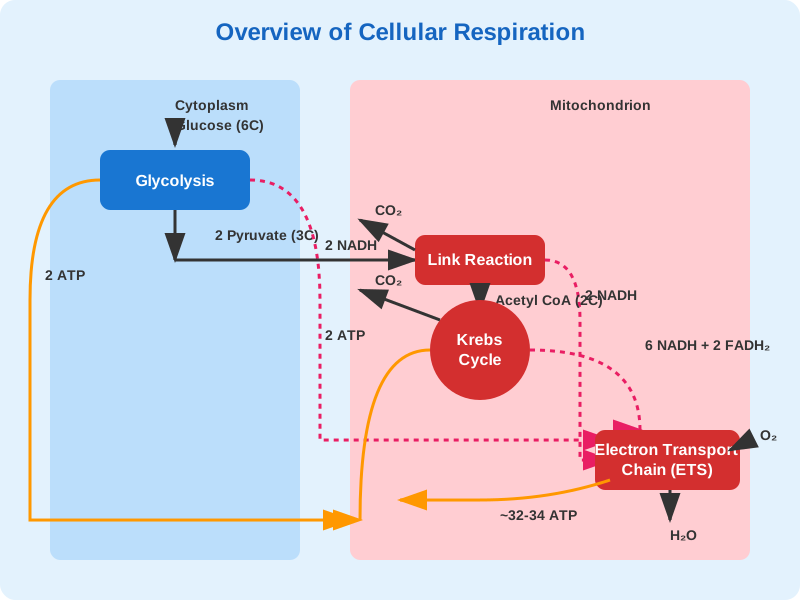
Figure 12.1: Outline of Aerobic Respiration
Electron Transport System (ETS) and Oxidative Phosphorylation
The metabolic pathway through which the electron passes from one carrier to another, is called the electron transport system (ETS) and it is present in the inner mitochondrial membrane. When electrons pass from one carrier to another via complex I to IV in the electron transport chain, they are coupled to ATP synthase (complex V) for the production of ATP from ADP and inorganic phosphate. The number of ATP molecules synthesised depends on the nature of the electron donor. Oxidation of one molecule of NADH gives rise to 3 molecules of ATP, while that of one molecule of $FADH_2$ produces 2 molecules of ATP. Oxygen acts as the final hydrogen acceptor.
Amphibolic Pathway
Glucose is the favoured substrate for respiration. All carbohydrates are usually first converted into glucose before they are used for respiration. Other substrates can also be respired, but they do not enter the respiratory pathway at the very first step. Because the respiratory pathway is involved in both breakdown (catabolism) and synthesis (anabolism) of molecules, it is better considered an amphibolic pathway.
Respiratory Quotient
The ratio of the volume of $CO_2$ evolved to the volume of $O_2$ consumed in respiration is called the respiratory quotient (RQ) or respiratory ratio. $$ RQ = \frac{\text{volume of } CO_2 \text{ evolved}}{\text{volume of } O_2 \text{ consumed}} $$ The respiratory quotient depends upon the type of respiratory substrate used during respiration. For carbohydrates, RQ is 1. For fats, it is less than 1.
Competency Based Questions (Previous Years & Sample Papers)
Q1. The complete combustion of Tripalmitin, a common triglyceride fat, is represented by the following chemical equation: $2(C_{51}H_{98}O_6) + 145O_2 \rightarrow 102CO_2 + 98H_2O + \text{Energy}$ Calculate the Respiratory Quotient (RQ) for the aerobic respiration of tripalmitin. If a plant’s measured RQ over a 24-hour period shifts from $1.0$ to $0.7$, what fundamental metabolic shift has likely occurred regarding its primary respiratory substrate?
Answer
Mathematical Calculation: The Respiratory Quotient (RQ) is defined as: $$ RQ = \frac{\text{Volume of } CO_2 \text{ evolved}}{\text{Volume of } O_2 \text{ consumed}} $$ From the balanced chemical equation, the stoichiometric coefficients indicate the relative volumes of gases (via Avogadro’s law). Volume of $CO_2$ evolved = $102$ Volume of $O_2$ consumed = $145$
$$ RQ_{\text{Tripalmitin}} = \frac{102}{145} $$ $$ RQ \approx 0.703 $$ The RQ is approximately $0.7$.
Metabolic Shift: An RQ of exactly $1.0$ indicates that the plant is primarily oxidizing carbohydrates (like glucose or starch) for energy. A shift to an RQ of $0.7$ strongly indicates that the plant has exhausted its available carbohydrate reserves and has shifted to beta-oxidation of fats/lipids as its primary respiratory substrate to generate ATP.
Q2. During glycolysis, a 6-carbon glucose molecule is broken down into two 3-carbon pyruvate molecules. This sequence involves an initial “investment” phase and a “payoff” phase. Let $-I$ be the number of ATP molecules consumed per glucose, and $+P$ be the number of ATP molecules directly generated via substrate-level phosphorylation per glucose. Write the balanced equation for the net ATP yield ($Net_{ATP} = P - I$). If a metabolic toxin completely inhibits the enzyme Phosphofructokinase (an enzyme in the investment phase), mathematically what is the functional ATP yield of glycolysis?
Answer
Glycolysis ATP Balance:
- Investment phase ($I$): 2 ATP are consumed (one to phosphorylate glucose to glucose-6-phosphate, and one to phosphorylate fructose-6-phosphate to fructose-1,6-bisphosphate). So, $I = 2$.
- Payoff phase ($P$): 4 ATP are directly generated via substrate-level phosphorylation (two from 1,3-bisphosphoglycerate and two from phosphoenolpyruvate) for every one glucose molecule (since 2 trioses are formed). So, $P = 4$.
Net ATP yield equation: $$ Net_{ATP} = P - I = 4 - 2 = 2 \text{ ATP} $$
Effect of Toxin: Phosphofructokinase (PFK) catalyzes the second ATP investment step (fructose-6-phosphate to fructose-1,6-bisphosphate). If this enzyme is completely inhibited, the pathway is severely bottlenecked. Mathematically, the cell has spent $1$ ATP (on Hexokinase) but cannot reach the cleavage step (Aldolase) to create the trioses that eventually produce the $4$ payoff ATPs. Therefore, $P$ becomes $0$. The investment $I$ is stuck at $1$. Functional net ATP yield = $0 - 1 = \mathbf{-1 \text{ ATP}}$. The cell continuously loses ATP trying to run glycolysis until it dies. Hence, PFK is precisely regulated as the major pacemaker of glycolysis.
Q3. Consider the theoretical ATP yield of aerobic respiration in classical eukaryotic models, where 1 NADH generates approximately 3 ATP, and 1 $FADH_2$ generates approximately 2 ATP. For a single glucose molecule undergoing complete oxidation, the net tallies are: - Glycolysis: 2 net ATP + 2 cytosolic NADH - Link Reaction: 2 NADH - Krebs Cycle: 2 ATP + 6 NADH + 2 $FADH_2$ If the cell uses the glycerol-3-phosphate shuttle (which transfers electrons from cytosolic NADH to mitochondrial FAD, dropping their energetic value to that of $FADH_2$), formulate an equation summing the total theoretical ATP. Conversely, what is the total if it uses the malate-aspartate shuttle (which retains the NADH value)?
Answer
Let’s sum the contributions components.
- Substrate-level ATP: $2 \text{ (Glycolysis)} + 2 \text{ (Krebs)} = \mathbf{4 \text{ ATP}}$
- Mitochondrial NADH (Link + Krebs): $2 + 6 = \mathbf{8 \text{ NADH}}$. Yield = $8 \cdot 3 = \mathbf{24 \text{ ATP}}$
- Mitochondrial $FADH_2$ (Krebs): $\mathbf{2 \text{ } FADH_2}$. Yield = $2 \cdot 2 = \mathbf{4 \text{ ATP}}$
- Cytosolic NADH (Glycolysis): $\mathbf{2 \text{ NADH}}$
Scenario 1: Glycerol-3-Phosphate Shuttle The 2 cytosolic NADH are essentially converted to $FADH_2$ equivalents inside the mitochondria. Yield of these 2 carriers = $2 \cdot 2 \text{ ATP/carrier} = \mathbf{4 \text{ ATP}}$. Total ATP = Substrate ATP (4) + Mito NADH ATP (24) + Mito $FADH_2$ ATP (4) + Shuttle ATP (4) $$ \text{Total} = 4 + 24 + 4 + 4 = \mathbf{36 \text{ ATP}} $$
Scenario 2: Malate-Aspartate Shuttle The 2 cytosolic NADH are shuttled efficiently to mitochondrial $NAD^+$, retaining their full value. Yield of these 2 carriers = $2 \cdot 3 \text{ ATP/carrier} = \mathbf{6 \text{ ATP}}$. Total ATP = Substrate ATP (4) + Mito NADH ATP (24) + Mito $FADH_2$ ATP (4) + Shuttle ATP (6) $$ \text{Total} = 4 + 24 + 4 + 6 = \mathbf{38 \text{ ATP}} $$
Therefore, depending on the shuttle, theoretical yield oscillates between 36 and 38 ATP.