Chapter 13: Plant - Growth and Development
You have already studied the organisation of a flowering plant in Chapter 5. Have you ever thought about where and how the structures like roots, stems, leaves, flowers, fruits and seeds arise and that too in an orderly sequence? Plant growth is virtually unlimited because they retain the capacity for unlimited growth throughout their life. This ability of the plants is due to the presence of meristems at certain locations in their body.
Growth and Development
Growth can be defined as an irreversible permanent increase in size of an organ or its parts or even of an individual cell. Generally, growth is accompanied by metabolic processes (both anabolic and catabolic), that occur at the expense of energy.
- Phases of Growth: The period of growth is generally divided into three phases, namely, meristematic, elongation and maturation.
- Arithmetic Growth: Following mitotic cell division, only one daughter cell continues to divide while the other differentiates and matures. (Mathematical expression: $L_t = L_0 + rt$).
- Geometric Growth: In most systems, the initial growth is slow (lag phase), and it increases rapidly thereafter – at an exponential rate (log or exponential phase). Both progeny cells following mitotic cell division retain the ability to divide. (Mathematical expression: $W_1 = W_0 e^{rt}$).
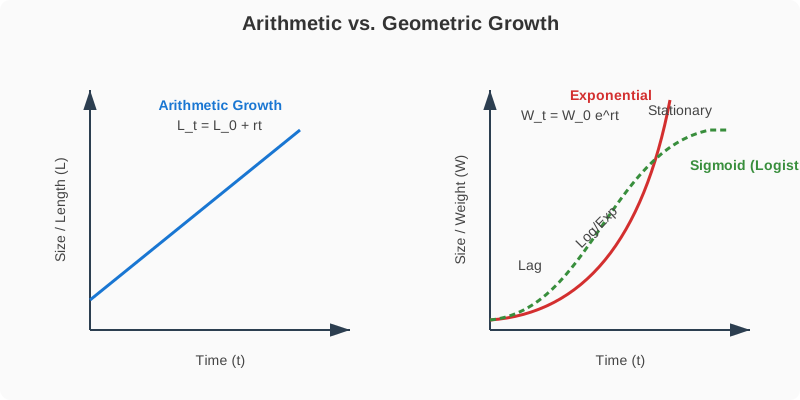
Figure 13.1: Graphical representation of Arithmetic vs Geometric Growth
Differentiation, Dedifferentiation and Redifferentiation
- Differentiation: The cells derived from root apical and shoot-apical meristems differentiate and mature to perform specific functions. During differentiation, cells undergo few to major structural changes both in their cell walls and protoplasm.
- Dedifferentiation: The living differentiated cells, that by now have lost the capacity to divide can regain the capacity of division under certain conditions. This phenomenon is termed as dedifferentiation.
- Redifferentiation: Plant products of dedifferentiation once again lose the capacity to divide and mature to perform specific functions.
Plant Growth Regulators (PGRs)
The plant growth regulators (PGRs) are small, simple molecules of diverse chemical composition.
- Auxins: (e.g., IAA) Induce rooting, apical dominance, and prevent premature fruit drop.
- Gibberellins: (e.g., $GA_3$) Cause elongation of intact stems, bolting in rosette plants, and delay senescence.
- Cytokinins: (e.g., Zeatin) Induce cell division, overcome apical dominance, and promote lateral shoot growth.
- Ethylene: A gaseous PGR. Highly effective in fruit ripening and inducing senescence and abscission of plant organs.
- Abscisic acid (ABA): Acts as a general plant growth inhibitor and an inhibitor of plant metabolism. It stimulates the closure of stomata (stress hormone).
Competency Based Questions (Previous Years & Sample Papers)
Q1. Consider the geometric (exponential) growth of a bacterial colony, modeled by the equation $W_t = W_0 e^{rt}$, where $W_t$ is the final population size, $W_0$ is the initial population size, $e$ is the base of natural logarithms ($\approx 2.718$), $r$ is the relative growth rate, and $t$ is time. A culture starts with exactly $1,000$ cells ($W_0=1000$). After $10$ hours ($t=10$), the population has grown to exactly $1,000,000$ cells. Calculate the specific relative growth rate $r$ per hour for this colony. Provide the answer in terms of natural logarithm ($\ln$). Why does a plant’s overall growth eventually deviate from this exponential model?
Answer
Mathematical Calculation: Given: $W_0 = 1,000$ $W_t = 1,000,000$ $t = 10 \text{ hours}$ Equation: $W_t = W_0 e^{rt}$
Substitute the known values: $$ 1,000,000 = 1000 \cdot e^{r \cdot 10} $$ Divide both sides by $1,000$: $$ 1000 = e^{10r} $$ Take the natural logarithm ($\ln$) of both sides to isolate the exponent: $$ \ln(1000) = \ln(e^{10r}) $$ $$ \ln(10^3) = 10r $$ $$ 3\ln(10) = 10r $$ $$ r = \frac{3\ln(10)}{10} \text{ hour}^{-1} $$ (Alternatively, $r = \frac{\ln(1000)}{10}$). Approximately $r \approx 0.69 \text{ hr}^{-1}$.
Biological Justification: While early embryonic growth or bacterial cultures in fresh media grow exponentially, overall growth in plants and natural populations eventually deviates from this model and follows a logistic (sigmoid) curve. This deviation occurs because of limiting factors such as nutrient depletion, limited space, accumulation of toxic metabolic byproducts, and the eventual maturation and programmed senescence of tissues, forcing the growth rate to plateau (reaching the carrying capacity).
Q2. During tissue culture experiments, a piece of mature, differentiated potato parenchyma (the explant) is placed on a sterile nutrient medium containing specific Plant Growth Regulators (PGRs). The cells lose their specific differentiation and begin to divide to form an unorganized mass of cells called a callus. A few weeks later, adjusting the ratio of Auxins to Cytokinins causes the callus cells to stop dividing and mature into functional vascular tissue and roots. Identify and sequentially name the three biological cellular processes taking place in this entire sequence.
Answer
The sequence explicitly demonstrates the incredible plasticity of plant cells. The three sequential processes are:
- Differentiation (initial state): The potato parenchyma cells were already fully functional, mature cells that had lost their capacity to divide in the intact plant.
- Dedifferentiation: When placed in tissue culture with PGRs, the mature parenchyma cells regained their mitotic activity and dividing capacity, forming the undifferentiated mass of cells (callus).
- Redifferentiation: Upon changing the PGR ratio (specifically applying a higher ratio of Auxins to Cytokinins to induce root formation), the callus cells once again lost their ability to divide and matured to perform entirely specific new functions (becoming vascular tissue and roots).
Q3. Fruit growers often face the problem of synchronous fruit ripening. To quickly ripen an entire warehouse of green tomatoes uniformly, a specific volatile plant growth regulator is commonly pumped into the storage rooms. Name this specific PGR. Explain the biochemical mechanism by which this PGR accelerates ripening, and state one other commercially desirable physiological effect it has on crop plants when applied via aqueous solutions like ethephon.
Answer
PGR Identification: The specific volatile (gaseous) PGR is Ethylene.
Biochemical Mechanism: Ethylene accelerates fruit ripening by acting as a powerful hormone that triggers a massive, sudden spike in the respiration rate of the fruit, a phenomenon called the respiratory climacteric. It induces the transcription and translation of enzymes responsible for ripening: hydrolases (which break down starch into sweet sugars), pectinases (which dissolve the middle lamella, softening the fruit), and chlorophyllases (which break down green chlorophyll, revealing the red/yellow pigments underneath).
Other Commercial Effect: When applied as an aqueous solution (like ethephon), it is absorbed readily and releases ethylene slowly. Aside from ripening, it is highly desirable for inducing uniform fruit abscission for mechanical harvesting (e.g., in walnuts and cotton) or promoting female flowers in monoecious plants like cucumbers, which drastically increases the fruit yield.