Chapter 16: Excretory Products and their Elimination
Animals accumulate ammonia, urea, uric acid, carbon dioxide, water and ions like $Na^+$, $K^+$, $Cl^-$, phosphate, sulphate, etc., either by metabolic activities or by other means like excess ingestion. These substances have to be removed totally or partially. This chapter deals with the mechanisms of elimination of these substances with special emphasis on common nitrogenous wastes.
Ammonia, urea and uric acid are the major forms of nitrogenous wastes excreted by the animals. Ammonia is the most toxic form and requires large amount of water for its elimination, whereas uric acid, being the least toxic, can be removed with a minimum loss of water.
Human Excretory System
In humans, the excretory system consists of a pair of kidneys, one pair of ureters, a urinary bladder and a urethra. Kidneys are reddish brown, bean shaped structures situated between the levels of last thoracic and third lumbar vertebra close to the dorsal inner wall of the abdominal cavity.
Each kidney has nearly one million complex tubular structures called nephrons, which are the functional units. Each nephron has two parts – the glomerulus and the renal tubule.
The Nephron
Glomerulus is a tuft of capillaries formed by the afferent arteriole. Blood from the glomerulus is carried away by an efferent arteriole. The renal tubule begins with a double walled cup-like structure called Bowman’s capsule, which encloses the glomerulus. Glomerulus alongwith Bowman’s capsule, is called the Malpighian body or renal corpuscle. The tubule continues further to form a highly coiled network – Proximal Convoluted Tubule (PCT). A hairpin shaped Henle’s loop is the next part of the tubule which has a descending and an ascending limb. The ascending limb continues as another highly coiled tubular region called Distal Convoluted Tubule (DCT).
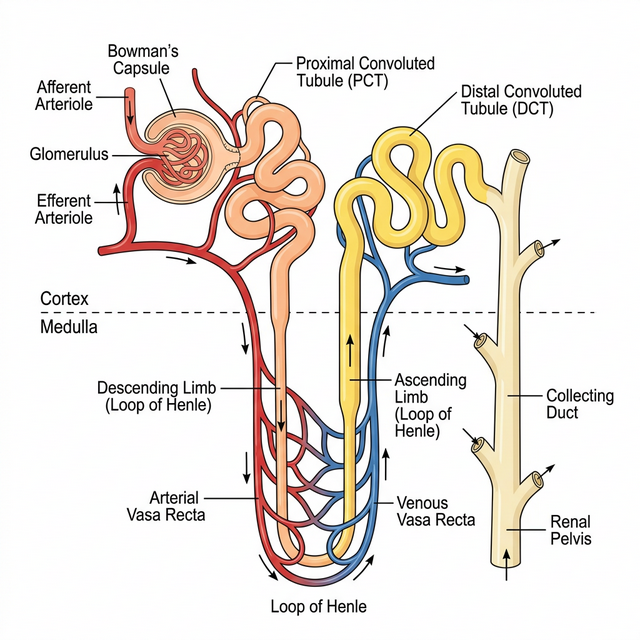
Figure 16.1: Structure of a typical Nephron
Urine Formation
Urine formation involves three main processes namely, glomerular filtration, reabsorption and secretion, that takes place in different parts of the nephron.
- Glomerular Filtration: The first step in urine formation is the filtration of blood, which is carried out by the glomerulus and is called glomerular filtration. On average, $1100-1200$ mL of blood is filtered by the kidneys per minute.
- Reabsorption: A comparison of the volume of the filtrate formed per day (180 litres per day) with that of the urine released (1.5 litres), suggest that nearly 99 per cent of the filtrate has to be reabsorbed by the renal tubules.
- Secretion: During urine formation, the tubular cells secrete substances like $H^+$, $K^+$ and ammonia into the filtrate.
Regulation of Kidney Function
The functioning of the kidneys is efficiently monitored and regulated by hormonal feedback mechanisms involving the hypothalamus, JGA and to a certain extent, the heart.
- Antidiuretic Hormone (ADH): Released from the posterior pituitary, it facilitates water reabsorption from latter parts of the tubule, thereby preventing diuresis (excess urine loss).
- Renin-Angiotensin mechanism: The JGA plays a complex regulatory role. A fall in glomerular blood pressure activates JG cells to release renin which converts angiotensinogen to angiotensin I and further to angiotensin II (a powerful vasoconstrictor and stimulator of aldosterone).
Competency Based Questions (Previous Years & Sample Papers)
Q1. The glomerular filtration rate (GFR) in a healthy adult is roughly $125 \text{ mL/min}$. The total plasma volume of an average human is approximately $3000 \text{ mL}$ (3 Liters). Calculate the number of times the entire plasma volume is filtered by the kidneys in a standard 24-hour day. If a pharmaceutical drug is specifically designed to completely block the sodium-glucose transport proteins (SGLT2) in the Proximal Convoluted Tubule, dynamically how will this alter the final urine output volume and its glucose concentration?
Answer
Mathematical Calculation:
-
Calculate total GFR per day: $GFR_{day} = 125 \text{ mL/min} \cdot 60 \text{ min/hour} \cdot 24 \text{ hours/day}$ $GFR_{day} = 125 \cdot 1440 = 180,000 \text{ mL/day}$ ($180 \text{ L/day}$)
-
Compare to Plasma Volume: $\text{Number of times filtered} = \frac{180,000 \text{ mL}}{3000 \text{ mL}} = \mathbf{60 \text{ times}}$. The entire blood plasma volume is filtered mathematically $60$ times every $24$ hours.
Drug Effect on Output: Under normal conditions, $100%$ of glucose is reabsorbed via SGLT2 transporters in the Proximal Convoluted Tubule (PCT). If this transporter is blocked by a drug (like an SGLT2 inhibitor used for diabetes):
- Glucose Concentration: Glucose is not reabsorbed and thus remains trapped in the tubular filtrate. The final urine will have a highly elevated glucose concentration (glucosuria).
- Urine Volume: Because glucose is an osmotically active solute, its presence in the tubule prevents the obligatory reabsorption of water via osmosis. This causes osmotic diuresis, resulting in a significantly increased final urine output volume (polyuria).
Q2. Desert mammals, such as the Kangaroo Rat, survive the harsh arid environment without ever needing to drink free water. Their survival depends exclusively on metabolic water generation and drastic minimization of excretory water loss. Structurally, the Kangaroo Rat has incredibly long Loops of Henle that extend deep into the inner medulla. According to the counter-current multiplier mechanism, biologically and mathematically, how does the extreme length of the Loop of Henle correlate to the extreme concentration (high osmolarity) of their final urine compared to humans?
Answer
Mechanism and Correlation: The principal function of the Loop of Henle is to create a massive osmolar gradient in the medullary interstitium. The ascending limb actively pumps out $NaCl$ but is strictly impermeable to water. The descending limb is highly permeable to water but impermeable to ions. Because the fluids flow in opposite directions (counter-current), the $NaCl$ pumped out by the ascending limb continuously “multiplies” the osmotic pressure acting on the descending limb.
Mathematically/Structurally: The concentrating power (the maximum osmolarity the medullary interstitium can reach) is directly proportional to the physical length of the Loop of Henle. A longer loop provides a vastly extended physical distance for the counter-current multiplier to establish a much steeper and higher concentration gradient deeply in the medulla. While human medullary tissue reaches a maximum of about $1200 \text{ mOsmolL}^{-1}$, the incredibly long loops of the Kangaroo rat allow their medulla to reach an astounding $5000-6000 \text{ mOsmolL}^{-1}$. When their collecting ducts pass completely through this highly concentrated medulla under the influence of ADH, massive amounts of water are osmotically reabsorbed back into the blood, producing highly concentrated, almost solid-like urine, effectively eliminating water loss almost entirely.
Q3. Uricotelism is the standard mode of excretion in terrestrial birds and reptiles. Uric acid is extremely insoluble in water, allowing these animals to excrete it as a semi-solid white paste with minimal water loss, which is highly advantageous for conserving water and minimizing body weight for flight. However, synthesizing uric acid from ammonia is an intensely energetically expensive multi-step biochemical pathway compared to producing urea or direct ammonia. Formulate an evolutionary argument explaining why natural selection favored this metabolically expensive pathway specifically for oviparous (egg-laying) terrestrial vertebrates.
Answer
Evolutionary Argument: The evolutionary development of uricotelism in birds and reptiles is directly tied to their mode of reproduction: the amniotic egg.
A terrestrial, shelled amniotic egg is a closed system. The developing embryo cannot constantly flush waste products out into a surrounding aquatic environment (like fish or amphibian embryos can with ammonia) nor can it transfer waste through a placenta to the mother’s blood (like mammalian embryos can with urea).
If a bird or reptile embryo produced ammonia or urea, these highly soluble, toxic compounds would accumulate instantly within the limited fluid of the egg, reaching lethal concentrations and poisoning the embryo long before it could hatch.
By expending the massive metabolic energy required to convert nitrogenous wastes into uric acid, the embryo yields a compound that is entirely insoluble in water. The uric acid rapidly precipitates out of the embryonic fluids as solid, harmless crystals. These crystals are stored safely in the allantois (a specialized extraembryonic sac) throughout incubation without altering the osmolarity or toxicity of the vital fluids, ensuring the embryo’s survival. Thus, the extreme energy cost is selected for because it exclusively permits reproduction inside a terrestrial egg.