Chapter 4: Principles of Inheritance and Variation
Introduction
Genetics is the subject that deals with the inheritance, as well as the variation of characters from parents to offspring. Inheritance is the process by which characters are passed on from parent to progeny; it is the basis of heredity.
Mendel’s Laws of Inheritance
Gregor Mendel, conducted hybridization experiments on garden peas (Pisum sativum) for seven years (1856-1863) and proposed the laws of inheritance in living organisms. He chose traits that had two contrasting characteristics, such as stem height (tall/dwarf), seed colour (yellow/green), etc.
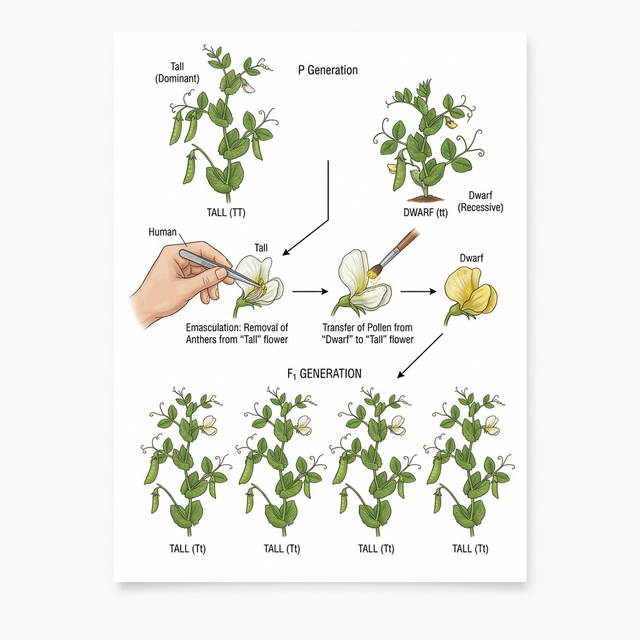
Inheritance of One Gene (Monohybrid Cross)
Mendel crossed tall and dwarf pea plants and obtained all tall plants in the \(F_1\) generation. When he self-pollinated the \(F_1\) tall plants, he observed both tall and dwarf plants in the \(F_2\) generation in a ratio of 3:1 (Phenotypic ratio) and 1:2:1 (Genotypic ratio).
Based on his observations on monohybrid crosses, Mendel proposed two general rules:
- Law of Dominance: Characters are controlled by discrete units called factors (genes). Factors occur in pairs. In a dissimilar pair, one member dominates (dominant) the other (recessive).
- Law of Segregation: The alleles do not show any blending. During gamete formation, the allelic pair segregates from each other such that a gamete receives only one of the two factors.
Deviations from Mendelism
- Incomplete Dominance: When the \(F_1\) phenotype does not resemble either of the two parents and is in between the two. Example: Flower color in snapdragon (Red \(RR\) crossed with White \(rr\) yields Pink \(Rr\)). The phenotypic ratio in \(F_2\) is \(1:2:1\).
- Co-dominance: When both alleles of a pair are fully expressed in a heterozygote. Example: ABO blood grouping in humans where alleles \(I^A\) and \(I^B\) are co-dominant, resulting in AB blood type.
- Multiple Alleles: When a character is controlled by more than two alleles. Example: ABO blood grouping is controlled by three alleles (\(I^A\), \(I^B\), \(i\)).
- Pleiotropy: Where a single gene exhibits multiple phenotypic expressions. Example: Phenylketonuria.
Two Gene Inheritance and Chromosomal Theory
Mendel also crossed plants differing in two traits (Dihybrid Cross), observing a 9:3:3:1 phenotypic ratio in \(F_2\), leading to the Law of Independent Assortment. It states that the inheritance of one pair of traits is independent of another pair.
Later, the Chromosomal Theory of Inheritance was proposed by Sutton and Boveri (1902). They noted that the behaviour of chromosomes is parallel to the behaviour of genes.
Linkage and Recombination: T.H. Morgan formulated the concept of linkage based on his work on Drosophila. Linkage refers to the physical association of genes on a chromosome, while recombination describes the generation of non-parental gene combinations.
Polygenic Inheritance
Traits that are controlled by three or more genes are called polygenic traits. Examples include human skin colour and human height. The phenotype reflects the contribution of each allele (additive effect), and the environment often influences the trait.
Sex Determination
The mechanism of sex determination relies on specific chromosomes known as sex chromosomes.
- Male heterogamety: Human males have XY chromosomes, producing X and Y sperms (50% each). Females have XX.
- Female heterogamety: In birds, females have ZW chromosomes, whereas males have ZZ.
- Haplodiploidy: In honey bees, females (queens, workers) are diploid (32 chromosomes) originating from fertilized eggs, and males (drones) are haploid (16 chromosomes) developing parthenogenetically from unfertilized eggs.
Genetic Disorders
Mendelian Disorders
Determined by alteration or mutation in a single gene. They follow Mendelian inheritance patterns.
- Haemophilia: Sex-linked recessive disease showing defective blood coagulation. A slight cut can lead to non-stop bleeding. A carrier female passes the disease to sons.
- Colour Blindness: Sex-linked recessive disorder where red-green discrimination is impaired. More common in males.
- Thalassemia: Autosomal recessive blood disease involving reduced synthesis of globin chains of hemoglobin, causing anemia.
Chromosomal Disorders
Caused by absence, excess, or abnormal arrangement of one or more chromosomes.
- Down’s Syndrome: Autosomal trisomy of chromosome 21 (resulting in 47 chromosomes).
- Turner’s Syndrome: Absence of one X chromosome in females (\(45,\text{XO}\)). Females are sterile and lack secondary sexual characters.
- Klinefelter’s Syndrome: Presence of an additional copy of X chromosome in males (\(47,\text{XXY}\)). Males are sterile with overall masculine development along with feminine features (e.g., gynecomastia).
Competency Based Questions
Q1. In a genetic mapping experiment, the recombination frequencies between three linked genes (A, B, and C) are as follows: A and B = \(15\%\), B and C = \(8\%\), A and C = \(23\%\). What is the correct linear sequence of these genes on the chromosome?
(A) A – C – B
(B) B – A – C
(C) A – B – C
(D) C – B – A
Answer and Explanation
Answer: (C) A – B – C or (D) C – B – AExplanation:
Recombination frequency is directly proportional to the physical distance between genes on a chromosome (1% recombination = 1 centiMorgan).
Distance A to C = 23 (The largest, hence A and C are at the extremes).
Distance A to B = 15.
Distance B to C = 8.
Since \(15 + 8 = 23\), B must be exactly in the middle of A and C.
The sequence is A—B—C or C—B—A.
Q2. A woman whose father was colour blind marries a man with normal vision. Assuming \(X^C\) represents the mutant allele, what is the probability that their first son will be colour blind? mathematically justify your answer.
Answer and Explanation
Answer: 50% probabilityExplanation:
Colour blindness is an X-linked recessive trait.
Woman’s father was colour blind: Genotype \(X^C Y\). Thus, he must have passed his \(X^C\) chromosome to his daughter.
Woman’s genotype: \(X^C X\) (Carrier, normal vision).
Man with normal vision: Genotype \(XY\).
Cross: \(X^C X \times XY\)
Possible offspring genotypes:
- Daughters: \(X^C X\) (Carrier) and \(XX\) (Normal).
- Sons: \(X^C Y\) (Colour blind) and \(XY\) (Normal).
Looking exclusively at the sons, there are 2 possibilities: one is normal, one is colour blind.
$$ \text{Probability} = \frac{1}{2} = 0.5 \text{ or } 50\% $$
Q3. Calculate the number of Barr bodies present in the somatic cell of an individual diagnosed with Klinefelter’s Syndrome.
Answer and Explanation
Answer: One Barr body.Explanation:
A Barr body is the heavily methylated, inactivated X chromosome typically found in female mammalian cells. The number of Barr bodies follows the \((N - 1)\) rule, where \(N\) is the total number of X chromosomes in the cell.
An individual with Klinefelter’s syndrome is a male with karyotype 47, XXY.
$$ N = 2 \text{ (Since there are two X chromosomes)} $$
$$ \text{Number of Barr bodies} = 2 - 1 = 1 $$
Q4. A cross was made between two heterozygotes (\(AaBb \times AaBb\)) exhibiting independent assortment. What fraction of the \(F_2\) progeny will be completely homozygous (either dominant or recessive for both traits)?
Answer and Explanation
Answer: \( \frac{1}{4} \) or \( \frac{4}{16} \)Explanation:
Using a Punnett square for a dihybrid cross (\(AaBb \times AaBb\)), there are 16 total offspring combinations.
Completely homozygous possibilities are:
- \(AABB\)
- \(AAbb\)
- \(aaBB\)
- \(aabb\)
Each of these specific genotypes occurs with a probability of:
$$ P(AA) \times P(BB) = \frac{1}{4} \times \frac{1}{4} = \frac{1}{16} $$
Since there are 4 such genotypes:
$$ \text{Total fraction} = \frac{1}{16} \times 4 = \frac{4}{16} = \frac{1}{4} $$
Q5. How does the concept of pleiotropy challenge Mendel’s initial assumption that one gene influences only one specific trait? Give one human example to support your answer.
Answer and Explanation
Answer: A single defective gene affects multiple unrelated phenotypic traits.Explanation:
Mendel believed that one gene controlled one character completely independently. Pleiotropy directly challenges this by showing that a single gene mutation can have multiple, seemingly unrelated phenotypic effects spread across different systems.
Example: Phenylketonuria. A mutation in the gene coding for the enzyme phenylalanine hydroxylase causes the primary metabolic defect. However, it leads to multiple phenotypic effects such as mental retardation, characteristic body odor, and reduced hair and skin pigmentation.