Chapter 5: Molecular Basis of Inheritance
The DNA
Deoxyribonucleic acid (DNA) and Ribonucleic acid (RNA) are the two types of nucleic acids found in living systems. DNA acts as the genetic material in most organisms. RNA mostly functions as a messenger, adapter, structural, and catalytic molecule.
Structure of Polynucleotide Chain
A nucleotide has three components: a nitrogenous base, a pentose sugar (ribose in RNA, and deoxyribose in DNA), and a phosphate group. There are two types of nitrogenous bases:
- Purines: Adenine (A) and Guanine (G).
- Pyrimidines: Cytosine (C), Thymine (T, only in DNA), and Uracil (U, only in RNA). A nitrogenous base is linked to the OH of 1’C pentose sugar through an N-glycosidic linkage to form a nucleoside. When a phosphate group is linked to the OH of 5’C of a nucleoside through a phosphoester linkage, a corresponding nucleotide is formed.
Double Helix Model
James Watson and Francis Crick (1953), based on X-ray diffraction data produced by Maurice Wilkins and Rosalind Franklin, proposed the Double Helix model for the structure of DNA.
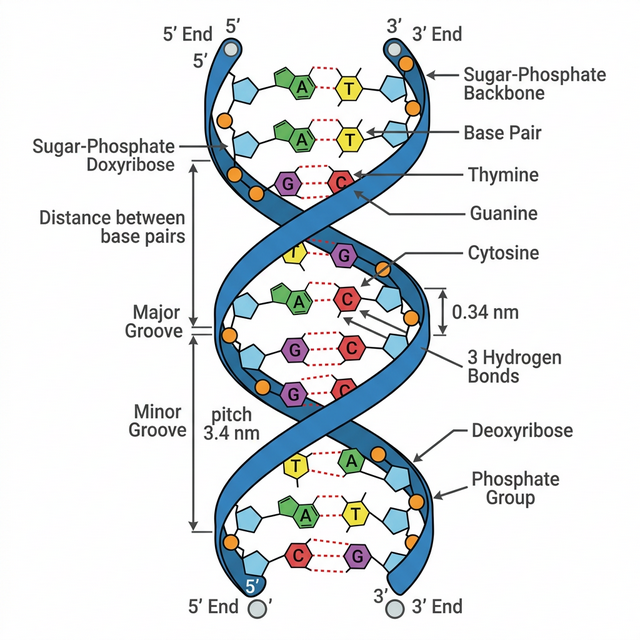
Key features:
- Made of two polynucleotide chains, with a sugar-phosphate backbone.
- The two chains have anti-parallel polarity (one is \(5’ \rightarrow 3’\), the other is \(3’ \rightarrow 5’\)).
- Bases project inside and are paired through Hydrogen bonds (A with T with two H-bonds; G with C with three H-bonds).
- The two chains are coiled in a right-handed fashion. Erwin Chargaff’s rule states that for a double-stranded DNA, the ratios between Adenine and Thymine, and Guanine and Cytosine are constant and equal one.
DNA Packaging
In prokaryotes like E. coli, DNA is held together with some proteins in a region called the nucleoid. In eukaryotes, there is a set of positively charged, basic proteins called histones. Histones are organized to form a unit of eight molecules called a histone octamer. The negatively charged DNA is wrapped around the positively charged histone octamer to form a structure called a nucleosome. Nucleosomes constitute the repeating unit of a structure in the nucleus called chromatin.
DNA Replication
Watson and Crick suggested a semi-conservative mechanism of replication. Matthew Meselson and Franklin Stahl (1958) proved it experimentally using heavy nitrogen (\(^{15}N\)) and E. coli. In eukaryotic replication, multiple origins of replication exist. The main enzyme is DNA-dependent DNA polymerase, which catalyzes polymerization highly efficiently in the \(5’ \rightarrow 3’\) direction. Consequently, on one strand (template with polarity \(3’ \rightarrow 5’\)), replication is continuous (leading strand), while on the other (\(5’ \rightarrow 3’\)), it is discontinuous (lagging strand). The discontinuous fragments (Okazaki fragments) are joined by DNA ligase.
Central Dogma
The Central Dogma in molecular biology states the flow of genetic information: DNA \(\xrightarrow{\text{Transcription}}\) mRNA \(\xrightarrow{\text{Translation}}\) Protein
Transcription
The process of copying genetic information from one strand of the DNA into RNA is termed transcription. A transcription unit in DNA is defined primarily by three regions:
- A Promoter
- The Structural gene
- A Terminator The enzyme DNA-dependent RNA polymerase catalyzes polymerization in only one direction, i.e., \(5’ \rightarrow 3’\). Therefore, the DNA strand with polarity \(3’ \rightarrow 5’\) acts as a template strand.
In eukaryotes, the primary transcript (hnRNA) undergoes processing:
- Splicing: Introns are removed and exons are joined.
- Capping: Methyl guanosine triphosphate is added to the 5’-end.
- Tailing: Polyadenylate tail (200-300 adenylate residues) is added to the 3’-end.
Genetic Code and Translation
The genetic code directs the sequence of amino acids during synthesis of proteins. Features of genetic code:
- It is a triplet (61 codons code for amino acids, 3 are stop codons).
- It is unambiguous and specific (one codon codes for only one amino acid).
- It is degenerate (some amino acids are coded by more than one codon).
- It is universal.
Translation refers to the process of polymerization of amino acids to form a polypeptide. The order and sequence of amino acids are defined by the sequence of bases in the mRNA. The cellular factory responsible for synthesizing proteins is the ribosome.
Regulation of Gene Expression
In prokaryotes, control of the rate of transcriptional initiation is the predominant site for control of gene expression. Lac Operon: The lac operon consists of one regulatory gene (the i gene, codes for the repressor) and three structural genes (z, y, and a). It is an inducible operon. Lactose acts as the inducer by binding to the repressor protein, bringing about a conformational change and preventing it from binding to the operator region, allowing RNA polymerase to transcribe the operon.
Human Genome Project (HGP) and DNA Fingerprinting
HGP (1990-2003) mapped the complete human genome (~\(3 \times 10^9\) bp). Key findings include that humans have approximately 30,000 genes, and 99.9% of DNA is exactly the same in all people. DNA Fingerprinting: Developed by Alec Jeffreys. It involves identifying differences in some specific regions in DNA sequence called repetitive DNA. It relies on Variable Number of Tandem Repeats (VNTRs) as probes that show very high degrees of polymorphism.
Competency Based Questions
Q1. Analysis of a double-stranded DNA sample shows that it contains 18% Cytosine. Calculate the percentage of Adenine in this sample based on Chargaff’s rule.
(A) 18%
(B) 32%
(C) 36%
(D) 64%
Answer and Explanation
Answer: (B) 32%Explanation:
According to Chargaff’s rule, in a double-stranded DNA molecule:
$$ \%C = \%G $$
$$ \%A = \%T $$
Therefore:
$$ \%C + \%G + \%A + \%T = 100\% $$
Given \(\%C = 18\%\), then \(\%G = 18\%\).
$$ \%C + \%G = 18\% + 18\% = 36\% $$
The remaining percentage must be shared equally by Adenine and Thymine:
$$ 100\% - 36\% = 64\% $$
$$ \%A = \%T = \frac{64\%}{2} = 32\% $$
Q2. During Meselson and Stahl’s experiment, E. coli grown in \(^{15}N\) medium was shifted to a \(^{14}N\) medium. If the replication time is 20 minutes, what would be the ratio of hybrid DNA to light DNA after 60 minutes?
Answer and Explanation
Answer: 1:3 (or 2 hybrid : 6 light strands)Explanation:
After 0 minutes: 100% heavy DNA (\(^{15}N-^{15}N\))
After 20 mins (1st generation): All DNA molecules are hybrid (\(^{15}N-^{14}N\)). Total = 2 molecules.
After 40 mins (2nd generation): 2 hybrid molecules and 2 light molecules (\(^{14}N-^{14}N\)). Total = 4 molecules.
After 60 mins (3rd generation): 2 hybrid molecules and 6 light molecules. Total = 8 molecules.
The number of hybrid molecules remains constant at 2 because there are only 2 original heavy \(^{15}N\) strands in the pool. The rest are newly synthesized light strands.
Ratio of Hybrid : Light = \(2 : 6 = 1 : 3\).
Q3. If the sequence of the coding strand in a transcription unit is written as follows:
5' - ATG CCT GAG CGT - 3'
Write down the sequence of the mRNA transcript.
Answer and Explanation
Answer: 5' - AUG CCU GAG CGU - 3'Explanation:
Since the coding strand does not code for anything but possesses the same sequence as the RNA (except that Thymine is replaced by Uracil), it’s a straightforward replacement.
Coding strand: 5' - ATG CCT GAG CGT - 3'
mRNA sequence: 5' - AUG CCU GAG CGU - 3'
Q4. The lac repressor is a tetrameric protein that binds to the operator sequence of the lac operon with a very high affinity (\(K_d \approx 10^{-13} M\)). Why does the addition of an inducer (like allolactose) successfully initiate transcription despite this high affinity?
Answer and Explanation
Answer: The inducer changes the structural conformation of the repressor.Explanation:
When allolactose (inducer) binds to the lac repressor protein, it acts as an allosteric effector. This binding induces a dramatic conformational change in the 3D structure of the repressor. The altered shape drastically lowers its binding affinity for the operator DNA sequence, causing the repressor to detach from the operator. With the operator free, RNA polymerase can now successfully bind to the promoter and transcribe the structural genes.
Q5. A geneticist synthesizes an artificial mRNA with purely repeating dinucleotides: 5'-UGUGUGUGUGUGUGUG-3'. In a cell-free translation system, how many different types of amino acids will make up the resulting polypeptide?
Answer and Explanation
Answer: Two different amino acids.Explanation:
Ribosomes read mRNA in non-overlapping triplets (codons) starting from the 5’ end.
Looking at the sequence: UGU GUG UGU GUG UGU GUG...
The codons are alternating exactly between UGU and GUG.
Since each specific codon calls for one specific amino acid, alternating UGU and GUG will bring alternating amino acids (Cysteine and Valine, respectively). Therefore, the polypeptide will be composed of exactly 2 different types of amino acids.