Chapter 3: Current Electricity
3.1 Electric Current and Drift Velocity
Electric current is the rate of flow of electric charges. By convention, its direction is treated as the direction of positive charge flow. \[I = \frac{dq}{dt}\] The SI unit is Ampere (\(\text{A}\)).
Drift Velocity and Mobility
In a metallic conductor, free electrons are in random thermal motion. However, when an electric field \(E\) is applied across the conductor, the electrons drift slowly opposite to the field with an average velocity known as drift velocity (\(v_d\)). The relation between current \(I\) and drift velocity is: \[I = n e A v_d\] where \(n\) is the number of free electrons per unit volume, \(e\) is the charge of an electron, and \(A\) is the cross-sectional area.
Mobility (\(\mu\)) is the magnitude of the drift velocity per unit electric field: \[\mu = \frac{|v_d|}{E} = \frac{e \tau}{m}\] where \(\tau\) is the relaxation time (average time between two successive collisions) and \(m\) is the mass of the electron.
3.2 Ohm’s Law and Resistivity
Ohm’s Law states that the current \(I\) flowing through a conductor is directly proportional to the potential difference \(V\) across its ends, provided physical conditions like temperature remain constant. \[V = I R\] where \(R\) is the Resistance. The SI unit of resistance is Ohm (\(\Omega\)).
The resistance of a conductor is determined by its geometry and the material: \[R = \rho \frac{l}{A}\] where \(\rho\) is the resistivity of the material. Resistivity depends on the nature of the material and temperature, but is independent of dimensions. Conductivity \(\sigma = \frac{1}{\rho}\).
V-I Characteristics
Materials that obey Ohm’s law (like pure metals) are Ohmic conductors and have a linear V-I relation. Materials that do not obey Ohm’s law closely are called Non-Ohmic conductors (e.g., semiconductors, diodes), having a non-linear relationship.
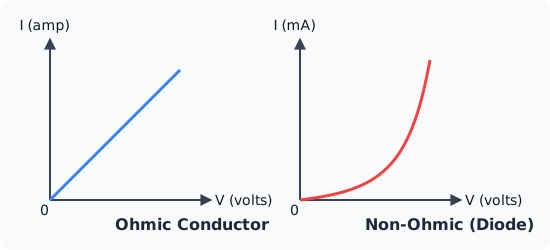
Temperature Dependence of Resistance
The resistivity of a metallic conductor increases with temperature: \[\rho_T = \rho_0 [1 + \alpha(T - T_0)]\] where \(\alpha\) is the temperature coefficient of resistivity.
3.3 Cells, EMF and Internal Resistance
A cell converts chemical energy into electrical energy.
- EMF (\(E\)): The potential difference across the terminals of a cell when no current is drawn (open circuit).
- Terminal Voltage (\(V\)): The potential difference when current is drawn.
- Internal Resistance (\(r\)): The resistance offered by the electrolyte inside the cell.
The relation between them is: \[V = E - I r\]
Grouping of Cells
- Series Combination: For \(n\) identical cells each of emf \(E\) and internal resistance \(r\): Equivalent EMF = \(nE\), Equivalent internal resistance = \(nr\). Current \(I = \frac{nE}{R + nr}\) where \(R\) is external resistance.
- Parallel Combination: For \(m\) identical cells in parallel branches: Equivalent EMF = \(E\), Equivalent internal resistance = \(r/m\). Current \(I = \frac{E}{R + r/m}\).
3.4 Kirchhoff’s Rules
Kirchhoff formulated two rules for analyzing complex electrical circuits:
- Junction Rule (KCL): At any junction, the sum of currents entering is equal to the sum of currents leaving. (Based on conservation of charge). \(\sum I = 0\)
- Loop Rule (KVL): Inthe closed loop, the algebraic sum of changes in potential must be zero. (Based on conservation of energy). \(\sum \Delta V = 0\)
3.5 Wheatstone Bridge
A Wheatstone bridge is an arrangement of four resistances \(P, Q, R, S\) used to measure an unknown resistance accurately.
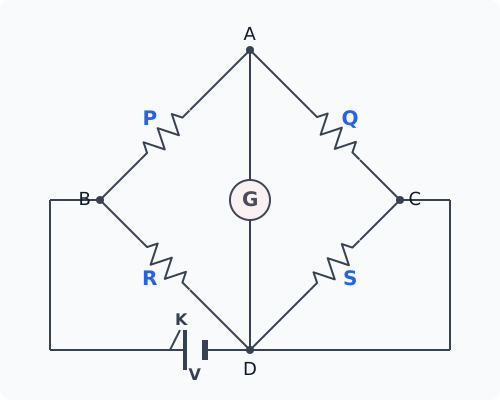
The bridge is said to be balanced when no current flows through the galvanometer (\(I_g = 0\)). In this condition: \[\frac{P}{Q} = \frac{R}{S}\] This principle is practically useful for determining unknown resistances with high precision.
Competency-Based Questions
Multiple Choice Questions
Q1. [CBSE 2025 Sample Paper] A current of \(2.0 \text{ A}\) flows through a copper wire. If the number density of conduction electrons is \(8.5 \times 10^{28} \text{ m}^{-3}\) and the cross-sectional area of the wire is \(1.0 \text{ mm}^2\), what is the drift velocity of electrons?
(A) \(1.5 \times 10^{-4} \text{ m/s}\)
(B) \(0.15 \text{ mm/s}\)
(C) Both A and B
(D) \(8.5 \times 10^{-4} \text{ m/s}\)
Answer:
Correct Option: (C)
Explanation: \(v_d = \frac{I}{n e A} = \frac{2.0}{8.5 \times 10^{28} \times 1.6 \times 10^{-19} \times 10^{-6}} = \frac{2}{13.6 \times 10^3} \approx 1.47 \times 10^{-4} \text{ m/s} = 0.147 \text{ mm/s}\). Thus approximately \(1.5 \times 10^{-4} \text{ m/s}\) and \(0.15 \text{ mm/s}\) are both correct variants.
Q2. [CBSE 2021] The terminal potential difference of a secondary cell of EMF \(12\text{ V}\) and internal resistance \(0.5\ \Omega\) which is being charged by a current of \(5\text{ A}\) is:
(A) \(12\text{ V}\)
(B) \(9.5\text{ V}\)
(C) \(14.5\text{ V}\)
(D) \(12.5\text{ V}\)
Answer:
Correct Option: (C)
Explanation: During charging, current enters the positive terminal. Therefore, the terminal potential difference is \(V = E + I r = 12 + (5 \times 0.5) = 12 + 2.5 = 14.5\text{ V}\).
Assertion-Reasoning Type Questions
Directions: In the following questions, a statement of Assertion (A) is followed by a statement of Reason (R). Choose the correct option: (A) Both A and R are true and R is the correct explanation of A. (B) Both A and R are true but R is NOT the correct explanation of A. (C) A is true but R is false. (D) A is false but R is true.
Q3. [CBSE 2024] Assertion (A): The drift velocity of electrons in a metallic wire decreases when the temperature of the wire is increased, assuming a constant potential difference across the wire. Reason (R): As temperature increases, the relaxation time of electrons decreases because the amplitude of vibration of positive ions increases.
Answer:
Correct Option: (A)
Explanation: Resistance \(R\) increases with temperature. For constant \(V\), current \(I = V/R\) decreases. Since \(I = neA v_d\), if \(I\) decreases, \(v_d\) must decrease. Also, \(v_d = \frac{eE \tau}{m}\). As temperature rises, ions vibrate more vigorously, causing more frequent collisions. Thus, the relaxation time \(\tau\) decreases, lowering the drift velocity. Hence, R is true and correctly explains A.
Case Study Based Question
Q4. Combining Cells for Maximum Current [CBSE 2022] You are given \(100\) identical cells, each having an EMF of \(1.5\text{ V}\) and internal resistance of \(1\ \Omega\). You are required to connect them to drive maximum current through an external resistor of \(4\ \Omega\). Suppose you form an arrangement of \(n\) rows in parallel, with each row containing \(m\) cells in series.
(i) For optimal current, what should be the total number of cells?
(A) \(mn = 50\)
(B) \(mn = 100\)
(C) \(m = 100, n = 1\)
(D) \(mn = 200\)
Answer:
Correct Option: (B)
Explanation: The total number of cells available and used must be \(m \times n = 100\).
(ii) The condition for maximum current in a mixed grouping of cells is that the external resistance equals the total internal resistance of the combination (\(R = \frac{mr}{n}\)). Based on this rule, what are the values of \(m\) and \(n\)?
(A) \(m = 10, n = 10\)
(B) \(m = 25, n = 4\)
(C) \(m = 20, n = 5\)
(D) \(m = 50, n = 2\)
Answer:
Correct Option: (C)
Explanation: We have \(mn = 100 \implies n = 100/m\).
Total internal resistance \(= \frac{m \times 1}{n} = \frac{m^2}{100}\).
For max current, \(R = \frac{mr}{n} \implies 4 = \frac{m^2}{100} \implies m^2 = 400 \implies m = 20\).
Then \(n = \frac{100}{20} = 5\). Thus, 5 rows of 20 cells in series give maximum current.