Chapter 4: Moving Charges and Magnetism
4.1 Magnetic Field and Oersted’s Experiment
In 1820, Hans Christian Oersted discovered that a compass needle suffers deflection when placed near a current-carrying wire. This indicated that a moving charge or electric current produces a magnetic field (\(\vec{B}\)) in the surrounding space. The SI unit of magnetic field is Tesla (\(\text{T}\)).
4.2 Biot-Savart Law
The Biot-Savart law gives the magnetic field \(d\vec{B}\) due to a small current element \((I\ d\vec{l})\) at a position vector \(\vec{r}\) from the element: \[d\vec{B} = \frac{\mu_0}{4\pi} \frac{I (d\vec{l} \times \vec{r})}{r^3} \quad \text{or} \quad |d\vec{B}| = \frac{\mu_0}{4\pi} \frac{I\ dl\ \sin\theta}{r^2}\] where \(\mu_0 = 4\pi \times 10^{-7} \text{ T}\cdot\text{m/A}\) is the permeability of free space.
Application to Current-Carrying Circular Loop The magnetic field at the center of a circular loop of radius \(R\) carrying current \(I\) consists of \(N\) turns is: \[B = \frac{\mu_0 N I}{2R}\]
4.3 Ampere’s Circuital Law
Ampere’s Law states that the line integral of the magnetic field \(\vec{B}\) around any closed path in free space is equal to \(\mu_0\) times the net current \(I\) enclosed by the path: \[\oint \vec{B} \cdot d\vec{l} = \mu_0 I\]
Applications of Ampere’s Law
1. Infinitely Long Straight Wire The magnetic field at a distance \(r\) from an infinitely long straight wire carrying current \(I\) is: \[B = \frac{\mu_0 I}{2\pi r}\] The magnetic field lines are concentric circles around the wire.
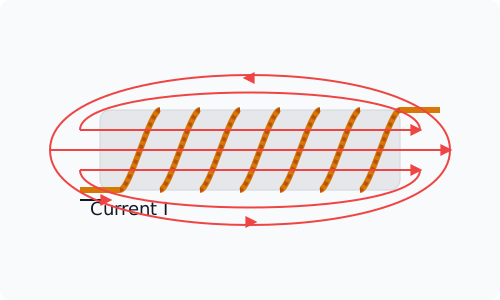
2. The Solenoid A solenoid is a long tightly wound coil. When a current flows through it, the magnetic field inside is uniform and strong, given by: \[B = \mu_0 n I\] where \(n\) is the number of turns per unit length (\(n = N/L\)). Outside the solenoid, the field is negligibly weak.
4.4 Force on a Moving Charge (Lorentz Force)
When a charge \(q\) moves with a velocity \(\vec{v}\) in a region where both electric field \(\vec{E}\) and magnetic field \(\vec{B}\) exist, it experiences a total force known as the Lorentz force: \[\vec{F} = q(\vec{E} + \vec{v} \times \vec{B})\]
The magnetic part of the force is \(\vec{F}_m = q(\vec{v} \times \vec{B})\). Its magnitude is \(F_m = qvB\sin\theta\). If the charge moves parallel or anti-parallel to the magnetic field (\(\theta = 0\) or \(180^\circ\)), the magnetic force is zero.
4.5 Magnetic Force on a Current-Carrying Conductor
A conductor of length \(l\) carrying current \(I\) placed in a uniform magnetic field \(\vec{B}\) experiences a force: \[\vec{F} = I (\vec{l} \times \vec{B})\] The direction of this force is given by Fleming’s Left-Hand Rule.
Force between Two Parallel Currents
When two parallel, infinitely long conductors carry currents \(I_1\) and \(I_2\) placed at a distance \(d\) apart, the force per unit length between them is: \[f = \frac{\mu_0 I_1 I_2}{2\pi d}\] Currents flowing in the same direction attract each other, and opposite directions repel.
Definition of Ampere: One Ampere is that steady current which, when flowing in each of two infinitely long parallel conductors separated by \(1\text{ m}\) in vacuum, produces an attractive or repulsive force of \(2 \times 10^{-7} \text{ N}\) per meter of length on them.
4.6 Torque on a Current Loop
A rectangular loop of area \(A\), carrying current \(I\), with \(N\) turns, placed in a uniform magnetic field \(B\), experiences a torque: \[\vec{\tau} = N I (\vec{A} \times \vec{B}) = \vec{m} \times \vec{B}\] where \(\vec{m} = NIA\hat{n}\) is the magnetic dipole moment of the loop.
Moving Coil Galvanometer
A moving coil galvanometer uses this principle. A coil placed in a radial magnetic field experiences a deflecting torque \(\tau_d = NIAB\), which is balanced by a restoring torque \(\tau_r = k\phi\) of the suspension spring. Therefore, \(I = \left(\frac{k}{NAB}\right) \phi\). The deflection \(\phi\) is directly proportional to the current \(I\).
Competency-Based Questions
Multiple Choice Questions
Q1. [CBSE 2025 Sample Paper] Two infinitely long parallel wires carrying currents \(10 \text{ A}\) and \(20 \text{ A}\) in opposite directions are separated by \(10 \text{ cm}\). The magnitude of the force acting on a \(2 \text{ m}\) length of each wire is:
(A) \(8 \times 10^{-4} \text{ N}\)
(B) \(4 \times 10^{-4} \text{ N}\)
(C) \(8 \times 10^{-5} \text{ N}\)
(D) \(2 \times 10^{-3} \text{ N}\)
Answer:
Correct Option: (A)
Explanation: Force per unit length \(f = \frac{\mu_0 I_1 I_2}{2\pi d} = \frac{4\pi \times 10^{-7} \times 10 \times 20}{2\pi \times 0.1} = 4 \times 10^{-4} \text{ N/m}\).
Total force on \(2 \text{ m}\) length \(F = f \times 2 = 8 \times 10^{-4} \text{ N}\).
Q2. [CBSE 2021] An electron is moving with a velocity \(\vec{v} = (5\hat{i} + 3\hat{j}) \text{ m/s}\) in a uniform magnetic field \(\vec{B} = 4\hat{k} \text{ T}\). The force acting on the electron is:
(A) \(-16 \times 10^{-19} \hat{i} + 32 \times 10^{-19} \hat{j} \text{ N}\)
(B) \(-19.2 \times 10^{-19} \hat{i} + 32 \times 10^{-19} \hat{j} \text{ N}\)
(C) \(19.2 \times 10^{-19} \hat{i} - 32 \times 10^{-19} \hat{j} \text{ N}\)
(D) \(32 \times 10^{-19} \hat{i} + 19.2 \times 10^{-19} \hat{j} \text{ N}\)
Answer:
Correct Option: (B)
Explanation: Force \(\vec{F} = q(\vec{v} \times \vec{B})\). For an electron, \(q = -1.6 \times 10^{-19} \text{ C}\).
\(\vec{v} \times \vec{B} = (5\hat{i} + 3\hat{j}) \times (4\hat{k}) = 20(\hat{i} \times \hat{k}) + 12(\hat{j} \times \hat{k}) = -20\hat{j} + 12\hat{i}\).
\(\vec{F} = -1.6 \times 10^{-19} \times (12\hat{i} - 20\hat{j}) = (-19.2\hat{i} + 32\hat{j}) \times 10^{-19} \text{ N}\).
Assertion-Reasoning Type Questions
Q3. [CBSE 2024] Assertion (A): A positive charge moving parallel to a current-carrying straight wire is pulled towards the wire if the charge and current are moving in the same direction. Reason (R): The magnetic force acting on the charge is zero because it moves parallel to the magnetic field.
Answer:
Correct Option: (C)
Explanation: The magnetic field produced by the wire at the position of the charge is perpendicular to the wire. Thus, the charge’s velocity is perpendicular to the magnetic field, not parallel. By Fleming’s Left Hand Rule, the force on a positive charge moving parallel to the current is directed towards the wire. Hence A is true but R is false.
Case Study Based Question
Q4. Moving Coil Galvanometer [CBSE 2021] A moving coil galvanometer is an instrument used for detection and measurement of small electric currents. When a current \(I\) passes through the coil, a magnetic torque acts on it, deflecting the coil. A restoring torque is produced in the phosphor-bronze suspension wire which brings the coil to equilibrium.
(i) To convert a galvanometer into an ammeter of desired range, we should connect:
(A) A high resistance in series.
(B) A low resistance in series.
(C) A high resistance in parallel.
(D) A low resistance in parallel.
Answer:
Correct Option: (D) To convert to ammeter, a very low resistance called shunt is connected in parallel so most current passes through the shunt.
(ii) Current sensitivity of a galvanometer is the deflection produced per unit current (\(I\)). It is equal to:
(A) \(\frac{NBA}{k}\)
(B) \(\frac{k}{NBA}\)
(C) \(\frac{NAB}{R}\)
(D) \(kNBA\)
Answer:
Correct Option: (A) Since \(I = \frac{k}{NBA} \phi\), current sensitivity is \(\frac{\phi}{I} = \frac{NBA}{k}\).