Chapter 5: Magnetism and Matter
5.1 The Bar Magnet
A bar magnet is a rectangular piece of an object that shows permanent magnetic properties. It has two poles: a North Pole (N) and a South Pole (S). Like poles repel each other, and unlike poles attract.
Magnetic Field Lines
The magnetic field lines of a magnet represent the magnetic field around it:
- They are continuous closed loops. They emanate from the North pole and merge at the South pole outside the magnet, and move from South to North inside.
- The tangent to the field line at any point gives the direction of the net magnetic field \(\vec{B}\).
- The larger the number of field lines crossing per unit area, the stronger the magnitude of the magnetic field \(\vec{B}\).
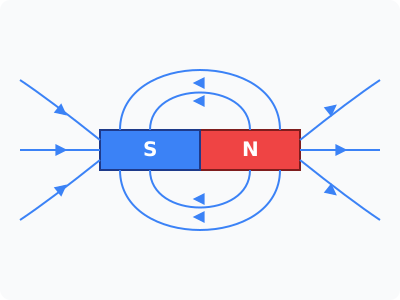
Bar Magnet as an Equivalent Solenoid
The magnetic field pattern of a bar magnet closely resembles that of a current-carrying solenoid. The magnetic dipole moment of a solenoid with \(N\) turns, area \(A\), carrying current \(I\) is \(m = NIA\). For a bar magnet of length \(2l\) and pole strength \(q_m\), \(m = q_m \times 2l\).
5.2 Magnetic Dipole in a Uniform Magnetic Field
The magnetic field at a distance \(r\) from the center of a magnetic dipole (bar magnet) of magnetic moment \(m\):
- On the Axial Line: \(B = \frac{\mu_0}{4\pi} \frac{2m}{r^3}\)
- On the Equatorial Line: \(B = \frac{\mu_0}{4\pi} \frac{m}{r^3}\)
Torque on a Magnetic Dipole
When a bar magnet (magnetic dipole) of moment \(\vec{m}\) is placed in a uniform magnetic field \(\vec{B}\), it experiences a torque: \[\vec{\tau} = \vec{m} \times \vec{B}\] The magnitude is \(\tau = mB\sin\theta\). It tends to align the dipole moment with the magnetic field.
5.3 Magnetic Properties of Materials
Materials can be broadly classified based on their behavior in a magnetic field into three categories:
-
Diamagnetic Materials: These materials are weakly repelled by a magnet. In an external magnetic field, they develop a weak induced magnetization in a direction opposite to the applied field.
- Examples: Bismuth, Copper, Water, Silicon.
- They move from the stronger to the weaker part of the non-uniform magnetic field.
-
Paramagnetic Materials: These materials get weakly attracted to a magnet. They have permanent atomic dipoles which tend to align in the direction of the external field.
- Examples: Aluminum, Sodium, Calcium, Oxygen (at STP).
- They tend to move from the weaker to the stronger part of a non-uniform field.
-
Ferromagnetic Materials: These materials get strongly attracted to a magnet. They can be permanently magnetized. In ferromagnets, the individual atomic dipoles interact strongly, forming domains which align perfectly with the external field.
- Examples: Iron, Cobalt, Nickel, and their alloys.
Magnetization and Temperature
- Magnetization (\(M\)) is defined as the net magnetic moment per unit volume.
- The susceptibility (\(\chi\)) of paramagnetic materials is inversely proportional to the absolute temperature \(T\) (Curie’s Law).
- For ferromagnetic materials, when temperature is raised beyond a certain point called Curie temperature (\(T_c\)), the material makes a transition from ferromagnetic to paramagnetic state due to the breakdown of domain structures by thermal agitation.
Competency-Based Questions
Multiple Choice Questions
Q1. [CBSE 2023] The magnetic susceptibility of a diamagnetic substance is:
(A) Small and positive
(B) Large and positive
(C) Small and negative
(D) Large and negative
Answer:
Correct Option: (C)
Explanation: Diamagnetic materials get weakly magnetized in the opposite direction to the applied external magnetic field, hence their susceptibility is small and negative (\(-1 \le \chi \lt 0\)).
Q2. [CBSE Sample Paper 2024] The work done in turning a magnet of magnetic moment \(M\) by an angle of \(90^\circ\) from the magnetic meridian is \(n\) times the corresponding work done to turn it through an angle of \(60^\circ\). The value of \(n\) is:
(A) \(1/2\)
(B) \(2\)
(C) \(1/4\)
(D) \(1\)
Answer:
Correct Option: (B)
Explanation: Work done \(W = \int \tau d\theta = MB(\cos\theta_1 - \cos\theta_2)\).
\(W_1\) (for \(90^\circ\) from meridian, so \(\theta_1=0\), \(\theta_2=90^\circ\)) = \(MB(1 - 0) = MB\).
\(W_2\) (for \(60^\circ\) from meridian, so \(\theta_1=0\), \(\theta_2=60^\circ\)) = \(MB(1 - 0.5) = 0.5 MB\).
Thus \(W_1 = 2 W_2\), so \(n=2\).
Assertion-Reasoning Type Questions
Q3. [CBSE 2022] Assertion (A): At Curie temperature, a ferromagnetic material becomes paramagnetic. Reason (R): The magnetic domains in a ferromagnetic material become completely randomized due to intense thermal agitation at Curie temperature.
Answer:
Correct Option: (A)
Explanation: Both assertion and reason are true, and the reason correctly explains the assertion. Thermal energy overcomes the exchange coupling between dipoles that keeps the domains aligned.
Case Study Based Question
Q4. Magnetic Dipole and Torques [CBSE 2024] A small compass needle of magnetic moment \(m\) is placed inside a uniform magnetic field \(B\). The needle is initially aligned with the magnetic meridian. Now, it is turned by an angle \(\theta\).
(i) The potential energy of the magnetic dipole in the external magnetic field is minimum when it is:
(A) parallel to the field
(B) perpendicular to the field
(C) antiparallel to the field
(D) inclined at \(45^\circ\) to the field
Answer:
Correct Option: (A)
Explanation: \(U = -mB\cos\theta\). Minimum potential energy occurs at \(\theta = 0^\circ\) (stable equilibrium), where \(U = -mB\).
(ii) Which of the following analogies between an electric dipole and a magnetic dipole is strictly incorrect based on isolated poles?
(A) Magnetic field aligns with electric field \(\vec{E} \leftrightarrow \vec{B}\)
(B) Dipole moment \(\vec{p} \leftrightarrow \vec{m}\)
(C) Isolated electric charge \(+q \leftrightarrow\) Isolated magnetic monopole \(N\).
(D) Potential energy forms \(-\vec{p} \cdot \vec{E} \leftrightarrow -\vec{m} \cdot \vec{B}\).
Answer:
Correct Option: (C)
Explanation: Isolated magnetic monopoles do not exist. Magnetic field lines always form closed continuous loops, unlike electric field lines which start at positive and end at negative charges.