Chapter 6: Electromagnetic Induction
6.1 Faraday’s Laws of Electromagnetic Induction
Michael Faraday discovered that an electric current can be induced in a loop or coil when there is a change in the magnetic flux linked with it. This phenomenon is called Electromagnetic Induction.
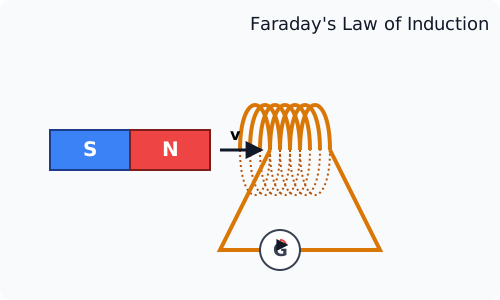
Faraday’s First Law: Whenever the magnetic flux linked with a circuit changes, an electromotive force (EMF) is induced in it. The induced EMF lasts as long as the change in magnetic flux continues.
Faraday’s Second Law: The magnitude of the induced EMF (\(e\)) is directly proportional to the rate of change of magnetic flux (\(\Phi_B\)) linked with the circuit. \[e = -\frac{d\Phi_B}{dt}\] If a coil has \(N\) turns, \(e = -N \frac{d\Phi_B}{dt}\).
6.2 Lenz’s Law
The negative sign in Faraday’s law represents Lenz’s Law, which gives the direction of the induced EMF or current. State: The direction of the induced current is such that it opposes the change in magnetic flux that produced it. Lenz’s law is a consequence of the law of conservation of energy. The mechanical work done against the opposing force in moving the magnet is converted into the electrical energy of the induced current.
6.3 Motional EMF
When a straight conductor of length \(l\) moves with velocity \(v\) perpendicular to a uniform magnetic field \(B\), an EMF is induced across its ends due to the magnetic Lorentz force on its free electrons. \[e = Bvl\]
6.4 Self-Induction and Mutual Induction
Self-Induction
It is the phenomenon of production of an induced EMF in a coil itself when the current passing through it changes. The magnetic flux \(\Phi\) linked with the coil is directly proportional to the current \(I\) flowing through it: \[\Phi = L I\] where \(L\) is the coefficient of self-induction or inductance of the coil. Its SI unit is Henry (\(\text{H}\)). The induced EMF is given by: \(e = -L \frac{dI}{dt}\)
The self-inductance of a long air-cored solenoid of length \(l\), area \(A\), and number of turns \(N\) is: \[L = \frac{\mu_0 N^2 A}{l}\]
Mutual Induction
It is the phenomenon of production of an induced EMF in one coil (secondary) due to a change of current in a neighboring coil (primary). \[\Phi_2 = M I_1\] where \(M\) is the coefficient of mutual induction or mutual inductance. The induced EMF in the secondary coil is: \(e_2 = -M \frac{dI_1}{dt}\)
The mutual inductance of two long coaxial solenoids is \(M = \frac{\mu_0 N_1 N_2 A}{l}\).
Competency-Based Questions
Multiple Choice Questions
Q1. [CBSE 2025 Sample Paper] A coil of area \(100\text{ cm}^2\) having \(500\) turns is placed in a magnetic field of \(0.5\text{ T}\) perpendicular to its plane. The magnetic field is reduced to zero in \(0.1\text{ s}\). The induced EMF in the coil is:
(A) \(50\text{ V}\)
(B) \(25\text{ V}\)
(C) \(2.5\text{ V}\)
(D) \(0.25\text{ V}\)
Answer:
Correct Option: (B)
Explanation: Initial flux \(\Phi_i = N B A = 500 \times 0.5 \times (100 \times 10^{-4}) = 2.5\text{ Wb}\).
Final flux \(\Phi_f = 0\).
Induced EMF \(|e| = \frac{\Delta\Phi}{\Delta t} = \frac{2.5 - 0}{0.1} = 25\text{ V}\).
Q2. [CBSE 2021] The energy stored in an inductor of inductance \(50\text{ mH}\) carrying a steady current of \(2\text{ A}\) is:
(A) \(0.1\text{ J}\)
(B) \(0.05\text{ J}\)
(C) \(10\text{ J}\)
(D) \(100\text{ J}\)
Answer:
Correct Option: (A)
Explanation: The energy stored in an inductor is \(U = \frac{1}{2}LI^2\).
\(U = \frac{1}{2} \times (50 \times 10^{-3}) \times (2)^2 = \frac{1}{2} \times 0.05 \times 4 = 0.1\text{ J}\).
Assertion-Reasoning Type Questions
Q3. [CBSE 2024] Assertion (A): An induced emf appears in any closed loop in which the magnetic flux changes, but a current flows only if the loop is a conductor. Reason (R): The existence of an induced emf is independent of the resistance of the loop, but the induced current depends inversely on the resistance.
Answer:
Correct Option: (A)
Explanation: Faraday’s law dictates that induced emf \(e = -\frac{d\Phi}{dt}\) regardless of the material of the loop. However, Ohm’s law \(I = e/R\) shows that current \(I\) will only be significant if the loop has low resistance (i.e., it is a conductor). Thus, R is true and is the correct explanation of A.
Case Study Based Question
Q4. Metal Detector [CBSE 2021] Most metal detectors used at airports work on the principle of electromagnetic induction. A typical detector contains two coils: a transmitter coil and a receiver coil. An alternating current is passed through the transmitter coil, creating a rapidly changing magnetic field. When a passenger carrying a metal object walks through the frame, the changing magnetic field induces eddy currents in the metal object. These eddy currents, in turn, produce their own alternating magnetic field, which induces a current in the receiver coil, triggering an alarm.
(i) The metal detector works on the principle of:
(A) Static electricity
(B) Electromagnetic induction
(C) Permanent magnetism
(D) Photoelectric effect
Answer:
Correct Option: (B) Electromagnetic Induction.
(ii) Eddy currents are produced in:
(A) Insulators only
(B) Conductors only
(C) Both conductors and insulators
(D) Vacuum
Answer:
Correct Option: (B) Eddy currents are current loops induced within bulk pieces of conductors when they are subjected to changing magnetic flux.