Chapter 7: Alternating Current
7.1 Alternating Currents and Voltages
An alternating current (AC) changes its magnitude continuously with time and reverses its direction periodically. \[I = I_0 \sin(\omega t) \quad \text{and} \quad V = V_0 \sin(\omega t)\] where \(I_0\) and \(V_0\) are peak values (amplitudes) of current and voltage, and \(\omega = 2\pi f\) is the angular frequency.
- Average Value: The average value of AC over a complete cycle is zero. The average over a half-cycle is \(I_{avg} = \frac{2 I_0}{\pi} \approx 0.637 I_0\).
- Root Mean Square (RMS) Value: The steady current that would produce the same heating effect in a resistor as is produced by the AC. \[I_{rms} = \frac{I_0}{\sqrt{2}} \approx 0.707 I_0 \quad \text{and} \quad V_{rms} = \frac{V_0}{\sqrt{2}}\] Normal AC ammeters and voltmeters measure rms values. Typical household supply in India is \(220\text{ V}\) (rms), \(50\text{ Hz}\).
7.2 AC Circuits
Reactance and Impedance
- Pure Resistor (\(R\)): Voltage and current are in same phase.
- Pure Inductor (\(L\)): Current lags behind the voltage by \(\pi/2\). Inductive Reactance \(X_L = \omega L\).
- Pure Capacitor (\(C\)): Current leads the voltage by \(\pi/2\). Capacitive Reactance \(X_C = \frac{1}{\omega C}\).
Series LCR Circuit
When an inductor (\(L\)), capacitor (\(C\)), and resistor (\(R\)) are connected in series to an AC source:
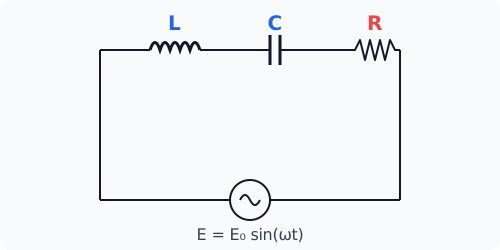
The total opposition offered by the circuit is called Impedance (\(Z\)): \[Z = \sqrt{R^2 + (X_L - X_C)^2}\]
The phase angle \(\phi\) by which voltage leads current is: \[\tan\phi = \frac{X_L - X_C}{R}\]
Resonance in LCR Circuit
Resonance occurs when \(X_L = X_C\), giving maximum current because impedance is minimum (\(Z = R\)). The resonant frequency is: \[\omega_r L = \frac{1}{\omega_r C} \implies \omega_r = \frac{1}{\sqrt{LC}} \implies f_r = \frac{1}{2\pi\sqrt{LC}}\]
7.3 Power in AC Circuits
The average power dissipated in an AC circuit over a complete cycle is: \[P_{avg} = V_{rms} I_{rms} \cos\phi\] where \(\cos\phi = \frac{R}{Z}\) is called the power factor.
- For a purely resistive circuit, \(\phi = 0 \implies \cos\phi = 1 \implies P_{avg} = V_{rms} I_{rms}\) (Max power).
- For a purely inductive/capacitive circuit, \(\phi = 90^\circ \implies \cos\phi = 0 \implies P_{avg} = 0\). The current doing no work is called wattless current.
7.4 AC Generator and Transformer
AC Generator
A device that converts mechanical energy into electrical energy (alternating EMF) through electromagnetic induction. A coil is rotated in a uniform magnetic field. \[e = NAB\omega \sin(\omega t)\]
Transformer
A device used to increase (step-up) or decrease (step-down) alternating voltages, working on the principle of mutual induction. It consists of two coils (Primary and Secondary) wound on a soft iron core. \[\frac{V_s}{V_p} = \frac{N_s}{N_p} = k\] where \(k\) is the transformation ratio.
- Step-up transformer: \(N_s > N_p, \ V_s > V_p\)
- Step-down transformer: \(N_s < N_p, \ V_s < V_p\) Assuming an ideal transformer (no energy loss), \(P_{in} = P_{out} \implies V_p I_p = V_s I_s \implies I_s = \frac{V_p}{V_s} I_p\).
Competency-Based Questions
Multiple Choice Questions
Q1. [CBSE 2023] In an LCR series circuit, at resonance, the phase difference between current and voltage is:
(A) \(\pi\)
(B) \(\pi/2\)
(C) \(\pi/4\)
(D) \(0\)
Answer:
Correct Option: (D)
Explanation: At resonance, \(X_L = X_C\), so \(Z = R\). Therefore, the circuit behaves as purely resistive, and the voltage and current are in the same phase (\(\phi = 0\)).
Q2. [CBSE Sample Paper 2024] A step-up transformer operates on a \(220\text{ V}\) line and supplies a load of \(2\text{ A}\). The ratio of primary and secondary windings is \(1:50\). The current in the primary is:
(A) \(100\text{ A}\)
(B) \(0.04\text{ A}\)
(C) \(20\text{ A}\)
(D) \(50\text{ A}\)
Answer:
Correct Option: (A)
Explanation: For an ideal transformer, \(V_p I_p = V_s I_s\). Also \(\frac{I_p}{I_s} = \frac{N_s}{N_p}\).
\(\implies I_p = I_s \left(\frac{N_s}{N_p}\right) = 2 \times \left(\frac{50}{1}\right) = 100\text{ A}\).
Assertion-Reasoning Type Questions
Q3. [CBSE 2022] Assertion (A): A capacitor blocks direct current (DC) but allows alternating current (AC) to pass through it. Reason (R): The capacitive reactance is inversely proportional to the frequency of the current.
Answer:
Correct Option: (A)
Explanation: \(X_C = \frac{1}{2\pi f C}\). For DC, frequency \(f = 0\), so \(X_C = \infty\) (it blocks DC). For AC, \(f > 0\), so \(X_C\) is finite, allowing current to pass. Thus, Reason is true and correctly explains Assertion.
Case Study Based Question
Q4. Power Transmission [CBSE 2024] Electric power is transmitted from generating stations to consumers over long distances through transmission lines. High voltages are used for transmission. At the generating station, step-up transformers are used to increase the voltage to \(132\text{ kV}\) or \(400\text{ kV}\). Near towns or cities, step-down transformers are used to reduce the voltage step by step to a safe value of \(220\text{ V}\) for households.
(i) The core of a transformer is laminated to:
(A) Increase the magnetic flux
(B) Reduce eddy current loss
(C) Reduce copper loss
(D) Prevent rusting
Answer:
Correct Option: (B) Lamination restricts the path of eddy currents, reducing the \(I^2R\) power loss in the core.
(ii) Why is electrical energy transmitted at very high voltages?
(A) To increase the speed of transmission
(B) To decrease power loss in transmission lines
(C) To prevent short circuits
(D) To reduce the cost of transformer equipment
Answer:
Correct Option: (B) Power transmitted \(P = VI\). For a given power \(P\), increasing the voltage \(V\) reduces the current \(I\). The power loss in the wires is \(I^2 R\). Reducing current significantly minimizes the heat loss in the transmission lines.