Chapter 8: Electromagnetic Waves
8.1 Displacement Current
According to Ampere’s circuital law, the line integral of magnetic field over a closed loop is \(\mu_0\) times the total current enclosed by the loop. However, Maxwell found an inconsistency in this law when applied to a charging capacitor. During charging, current flows through the connecting wires, but there is no conduction current between the plates of the capacitor. Yet, a magnetic field exists between the plates.
Maxwell resolved this by introducing the concept of displacement current (\(I_d\)), which arises due to a changing electric field (or changing electric flux) in the region. \[I_d = \varepsilon_0 \frac{d\Phi_E}{dt}\]
The generalized Ampere-Maxwell Law is: \[\oint \vec{B} \cdot d\vec{l} = \mu_0 (I_c + I_d) = \mu_0 \left(I_c + \varepsilon_0 \frac{d\Phi_E}{dt}\right)\] where \(I_c\) is the conduction current.
8.2 Electromagnetic Waves and Their Characteristics
Electromagnetic waves are coupled, time-varying electric and magnetic fields that propagate through space. They are produced by accelerated charges or oscillating dipoles.
Characteristics of EM Waves:
-
Transverse Nature: The electric (\(\vec{E}\)) and magnetic (\(\vec{B}\)) fields are mutually perpendicular to each other and perpendicular to the direction of wave propagation.
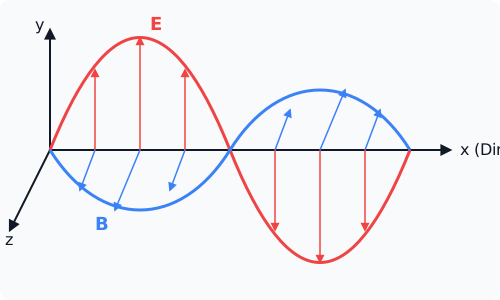
If the wave propagates along the x-axis, the electric field may oscillate along the y-axis, and the magnetic field along the z-axis. They obey the relation \(\hat{E} \times \hat{B} = \text{direction of propagation}\). 2. Speed: They travel in free space with the speed of light \(c = 3 \times 10^8 \text{ m/s}\). The speed is related to permittivity and permeability of free space by \(c = \frac{1}{\sqrt{\mu_0 \varepsilon_0}}\). 3. Amplitude Ratio: The magnitudes of electric and magnetic fields are related by \(c = \frac{E_0}{B_0}\). 4. Energy Momentum: EM waves carry energy and momentum, and exert radiation pressure.
8.3 Electromagnetic Spectrum
The classification of EM waves according to frequency (or wavelength) is known as the electromagnetic spectrum. Different parts of the spectrum are produced by different mechanisms and have different applications.
- Radio Waves: (\(> 0.1\text{ m}\))
- Produced by accelerated motion of charges in conducting wires.
- Used in radio and television communication systems.
- Microwaves: (\(0.1\text{ m}\) to \(1\text{ mm}\))
- Produced by special vacuum tubes (klystrons, magnetrons).
- Used in radar systems for aircraft navigation and microwave ovens.
- Infrared Waves: (\(1\text{ mm}\) to \(700\text{ nm}\))
- Produced by hot bodies and molecules. Also known as heat waves.
- Used in physical therapy, earth satellites, night vision goggles, and TV remote controls.
- Visible Light: (\(700\text{ nm}\) to \(400\text{ nm}\))
- The part of the spectrum that can be detected by the human eye.
- Produced by atomic excitations.
- Ultraviolet (UV) Rays: (\(400\text{ nm}\) to \(1\text{ nm}\))
- Produced by the sun and special lamps.
- Harmful UV is absorbed by the ozone layer. Used in water purifiers and checking forged documents.
- X-Rays: (\(1\text{ nm}\) to \(10^{-3}\text{ nm}\))
- Produced when high-energy electrons are stopped suddenly by a metal target.
- Used as a diagnostic tool in medicine for detecting fractures and in studying crystal structures.
- Gamma Rays: (\(< 10^{-3}\text{ nm}\))
- Produced in nuclear reactions and by radioactive nuclei.
- Used in medicine to destroy cancer cells.
Competency-Based Questions
Multiple Choice Questions
Q1. [CBSE 2023] The ratio of the amplitude of the magnetic field to the amplitude of the electric field for an electromagnetic wave propagating in a vacuum is equal to:
(A) The speed of light in vacuum
(B) Reciprocal of speed of light in vacuum
(C) The ratio of magnetic permeability to the electric susceptibility of vacuum
(D) Unity
Answer:
Correct Option: (B)
Explanation: We know \(c = \frac{E_0}{B_0}\). Therefore, \(\frac{B_0}{E_0} = \frac{1}{c}\), which is the reciprocal of the speed of light.
Q2. [CBSE Sample Paper 2024] Which of the following electromagnetic radiations has the highest frequency?
(A) X-rays
(B) Microwaves
(C) Gamma rays
(D) Ultraviolet rays
Answer:
Correct Option: (C)
Explanation: In the EM spectrum, gamma rays have the shortest wavelength and highest frequency.
Assertion-Reasoning Type Questions
Directions: Choose the correct option: (A) Both A and R are true and R is the correct explanation of A. (B) Both A and R are true but R is NOT the correct explanation of A. (C) A is true but R is false. (D) A is false but R is true.
Q3. [CBSE 2022] Assertion (A): Electromagnetic waves are transverse in nature. Reason (R): The electric and magnetic fields in an electromagnetic wave are perpendicular to each other and to the direction of propagation.
Answer:
Correct Option: (A)
Explanation: Transverse waves are characterized by oscillations perpendicular to the direction of energy transfer. The reason perfectly defines this characteristic for EM waves.
Case Study Based Question
Q4. The Ozone Layer and EM Spectrum [CBSE 2024] The earth’s atmosphere contains a layer of ozone gas in the stratosphere, approximately \(10\) to \(50\) km above the surface. This ozone layer absorbs a large portion of the shorter-wavelength part of the electromagnetic spectrum coming from the sun, specifically those wavelengths that are harmful to living organisms. Without this protective layer, life as we know it would not survive on land, as these high-energy waves would damage DNA and cause severe mutations.
(i) Which part of the electromagnetic spectrum is primarily absorbed by the ozone layer?
(A) Infrared rays
(B) Visible light
(C) Ultraviolet (UV) rays
(D) Microwaves
Answer:
Correct Option: (C) The ozone layer protects the earth from harmful ultraviolet radiations emitted by the sun.
(ii) Infrared radiations are often referred to as “heat waves” because:
(A) They are hot to touch
(B) They are readily absorbed by water molecules causing them to vibrate, resulting in heating
(C) Only hot bodies can reflect them
(D) They possess higher energy than X-rays
Answer:
Correct Option: (B) Infrared waves interact resonantly with the rotational and vibrational frequencies of water molecules, increasing their thermal motion which macroscopic level is heat.