Chapter 9: Ray Optics and Optical Instruments
9.1 Reflection of Light
When light strikes a polished surface, it bounces back into the same medium. This phenomenon is called reflection.
- The angle of incidence is equal to the angle of reflection (\(i = r\)).
- The incident ray, reflected ray, and the normal at the point of incidence all lie in the same plane.
Spherical Mirrors
Spherical mirrors are of two types:
- Concave Mirror: Reflecting surface is curved inwards.
- Convex Mirror: Reflecting surface is curved outwards.
The Mirror Formula relates the object distance (\(u\)), image distance (\(v\)) and focal length (\(f\)): \[\frac{1}{v} + \frac{1}{u} = \frac{1}{f}\] Focal length is half of the radius of curvature (\(f = R/2\)).
Linear Magnification (\(m\)): \[m = \frac{\text{Height of image} (h’)}{\text{Height of object} (h)} = -\frac{v}{u}\]
9.2 Refraction of Light
When light travels from one transparent medium to another, it changes its path (bends) at the interface. This occurs because the speed of light is different in different media.
Snell’s Law: The ratio of the sine of the angle of incidence to the sine of the angle of refraction is constant, called the refractive index (\(n_{21}\)) of the second medium with respect to the first: \[n_{21} = \frac{\sin i}{\sin r} = \frac{v_1}{v_2}\]
Total Internal Reflection (TIR)
When light travels from an optically denser medium to a rarer medium, and the angle of incidence exceeds the critical angle (\(i_c\)), the light gets completely reflected back into the denser medium. \[\sin i_c = \frac{n_{\text{rarer}}}{n_{\text{denser}}}\] Applications: Optical fibers use TIR to transmit light signals over long distances with minimal loss. Mirages and the brilliance of diamonds are also due to TIR.
9.3 Lenses
A lens is a transparent refracting material bound by two surfaces, at least one of which is spherical.
- Convex Lens (Converging): Thicker in the middle, thinner at the edges.
- Concave Lens (Diverging): Thinner in the middle, thicker at the edges.
Lens Maker’s Formula: \[\frac{1}{f} = (n_{21} - 1) \left(\frac{1}{R_1} - \frac{1}{R_2}\right)\] Thin Lens Formula: \[\frac{1}{f} = \frac{1}{v} - \frac{1}{u}\] Magnification (\(m\)): \[m = \frac{h’}{h} = \frac{v}{u}\]
Power of a Lens: The ability of a lens to converge or diverge rays is its power. \[P = \frac{1}{f (\text{in meters})}\] SI Unit is Diopter (\(\text{D}\)).
Combination of Lenses: When thin lenses are placed in contact, the equivalent focal length and power are: \[\frac{1}{F} = \frac{1}{f_1} + \frac{1}{f_2} + \dots \implies P = P_1 + P_2 + \dots\]
9.4 Refraction through a Prism
A prism is a wedge-shaped transparent body having two triangular bases and three rectangular surfaces.
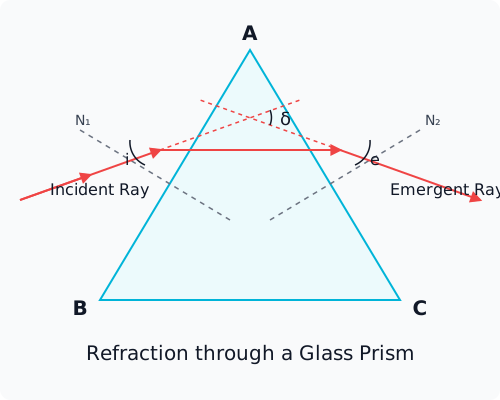
The relation between angle of prism (\(A\)), angle of deviation (\(\delta\)), angle of incidence (\(i\)) and emergence (\(e\)) is: \[i + e = A + \delta\]
For minimum deviation (\(\delta_{min}\)), \(i = e\) and \(r_1 = r_2\). The refractive index of the prism material is: \[n = \frac{\sin\left(\frac{A + \delta_{min}}{2}\right)}{\sin\left(\frac{A}{2}\right)}\]
9.5 Optical Instruments
Microscope
A device used to see highly magnified images of tiny objects.
- Simple Microscope: A single converging lens of small focal length.
- Compound Microscope: Consists of two converging lenses (Objective and Eyepiece). Magnifying power \(M \approx \frac{L}{f_o} \left(1 + \frac{D}{f_e}\right)\) for final image at near point \(D\).
Telescope
Used to provide angular magnification of distant objects.
- Refracting Telescope: Uses lenses. \(M = \frac{f_o}{f_e}\).
- Reflecting Telescope: Uses a parabolic mirror as an objective. It lacks chromatic aberration and has higher resolving power.
Competency-Based Questions
Multiple Choice Questions
Q1. [CBSE 2025 Sample Paper] The refractive index of glass with respect to water is \(9/8\). If the velocity and wavelength of light in glass are \(2 \times 10^8 \text{ m/s}\) and \(4000 \text{ }\mathring{A}\), then the velocity and wavelength of light in water are:
(A) \(2.25 \times 10^8 \text{ m/s}, 4500 \text{ }\mathring{A}\)
(B) \(2.25 \times 10^8 \text{ m/s}, 3500 \text{ }\mathring{A}\)
(C) \(1.78 \times 10^8 \text{ m/s}, 4500 \text{ }\mathring{A}\)
(D) \(1.78 \times 10^8 \text{ m/s}, 3500 \text{ }\mathring{A}\)
Answer:
Correct Option: (A)
Explanation: \(^w\mu_g = \frac{v_w}{v_g} = \frac{\lambda_w}{\lambda_g} = \frac{9}{8}\).
\(v_w = \frac{9}{8} v_g = \frac{9}{8} \times 2 \times 10^8 = 2.25 \times 10^8 \text{ m/s}\).
\(\lambda_w = \frac{9}{8} \lambda_g = \frac{9}{8} \times 4000 = 4500 \text{ }\mathring{A}\). Frequency remains constant during refraction.
Q2. [CBSE 2021] Two thin lenses of powers \(+5 \text{ D}\) and \(-2 \text{ D}\) are put in contact. The focal length of the combination is:
(A) \(+33.3 \text{ cm}\)
(B) \(-33.3 \text{ cm}\)
(C) \(+3 \text{ cm}\)
(D) \(-3 \text{ cm}\)
Answer:
Correct Option: (A)
Explanation: Equivalent power \(P = P_1 + P_2 = 5 - 2 = +3 \text{ D}\).
Equivalent focal length \(F = \frac{1}{P} = \frac{1}{3} \text{ m} = 33.33 \text{ cm}\).
Assertion-Reasoning Type Questions
Q3. [CBSE 2024] Assertion (A): A convex lens is used to correct hypermetropia (far-sightedness). Reason (R): A convex lens converges the light rays before they enter the eye, ensuring the image evaluates precisely on the retina.
Answer:
Correct Option: (A)
Explanation: In hypermetropia, the image of nearby objects forms behind the retina. A convex lens provides additional converging power, shifting the focus forward to the retina.
Case Study Based Question
Q4. Total Internal Reflection in Optical Fibers [CBSE 2023] Optical fibers consist of many long high-quality composite glass/quartz fibers. Each fiber is coated with a material having a lower refractive index than the core material. When light is incident on one end of the fiber at a small angle, it undergoes repeated total internal reflections along the length of the fiber without any significant loss of intensity, and finally emerges out.
(i) The core of the optical fiber has:
(A) Refractive index equal to the cladding
(B) Refractive index higher than the cladding
(C) Refractive index lower than the cladding
(D) Random refractive index
Answer:
Correct Option: (B) For Total Internal Reflection to occur, light must travel from a denser medium (core) to a rarer medium (cladding).
(ii) Which of the following conditions is necessary for Total Internal Reflection?
(A) Angle of incidence is less than critical angle
(B) Angle of deviation is maximum
(C) Angle of incidence is greater than critical angle
(D) Angle of incidence is equal to angle of emergence
Answer:
Correct Option: (C) TIR only happens when the incidence angle is greater than the critical angle (\(i > i_c\)).