Chapter 10: Wave Optics
10.1 Wavefront and Huygens’ Principle
Wavefront
A wavefront is defined as the continuous locus of all particles of a medium which are vibrating in the same phase at a given instant.
- Spherical Wavefront: Due to a point source at a finite distance.
- Cylindrical Wavefront: Due to a linear source (like a slit).
- Plane Wavefront: A small part of a spherical or cylindrical wavefront at a very large distance from the source.
Rays are geometrically completely perpendicular to the wavefronts.
Huygens’ Principle
It is a geometrical construction to determine the shape of a new wavefront at any instant.
- Every point on the given active wavefront acts as a fresh source of new disturbance, called secondary wavelets.
- The secondary wavelets spread out in all directions with the speed of light in that medium.
- The envelope (forward tangent) of these secondary wavelets at any given instant gives the new wavefront at that instant.
Huygens’ principle elegantly explains the laws of reflection (\(\angle i = \angle r\)) and refraction (Snell’s Law) perfectly.
10.2 Interference of Light
When two light waves of the same frequency and constant phase difference superimpose on each other, the resultant intensity is different from the sum of their separate intensities. This redistribution of light energy is called interference.
Coherent Sources
Two sources of light which continuously emit light waves of same frequency with a zero or constant phase difference are called coherent sources. Coherent sources are essential for obtaining a steady or sustained interference pattern.
Young’s Double Slit Experiment (YDSE)
Thomas Young provided the first experimental proof for the wave theory of light using the double-slit experiment.
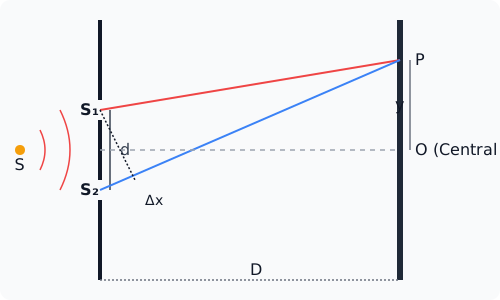
- Constructive Interference (Bright Fringes): Path difference \(\Delta x = n\lambda \ (n = 0, 1, 2, \dots)\)
- Destructive Interference (Dark Fringes): Path difference \(\Delta x = (2n - 1)\frac{\lambda}{2}\)
Fringe Width (\(\beta\)): The distance between two consecutive bright or dark fringes. \[\beta = \frac{\lambda D}{d}\] where \(\lambda\) is wavelength, \(D\) is distance of screen from slits, and \(d\) is separation between slits. All fringes in YDSE are of equal width.
10.3 Diffraction of Light
Diffraction is the phenomenon of bending of light around the corners of an obstacle or an aperture and entering into the region of geometrical shadow. This effect becomes significant when the size of the obstacle/aperture is comparable to the wavelength of light (\(\lambda \approx a\)).
Single Slit Diffraction
When a monochromatic plane wavefront falls on a narrow slit of width \(a\), it produces a diffraction pattern on a screen. The pattern consists of a central bright fringe (Central Maxima) surrounded by alternative dark and bright fringes of decreasing intensity (Secondary Maxima and Minima).
- Condition for Minima: \(a \sin\theta = n \lambda \ (n = 1, 2, 3, \dots)\)
- Condition for Secondary Maxima: \(a \sin\theta = (2n + 1)\frac{\lambda}{2}\)
Width of Central Maxima: The central bright maximum lies between the first min on either side (\(\theta = \pm \lambda/a\)). The angular width is \(\frac{2\lambda}{a}\). The linear width of the central maximum on a screen at distance \(D\) is \(w = \frac{2\lambda D}{a}\). As the slit width \(a\) increases, the diffraction pattern becomes narrower.
Competency-Based Questions
Multiple Choice Questions
Q1. [CBSE 2023] In Young’s double-slit experiment, if the separation between the slits \(d\) is halved and the distance to the screen \(D\) is doubled, the fringe width will become:
(A) Four times
(B) Two times
(C) Half
(D) One-fourth
Answer:
Correct Option: (A)
Explanation: Original fringe width \(\beta = \frac{\lambda D}{d}\).
New fringe width \(\beta’ = \frac{\lambda (2D)}{(d/2)} = 4 \left(\frac{\lambda D}{d}\right) = 4\beta\).
Q2. [CBSE Sample Paper 2024] Which of the following cannot be explained by the wave theory of light?
(A) Polarization
(B) Interference
(C) Diffraction
(D) Photoelectric effect
Answer:
Correct Option: (D)
Explanation: The photoelectric effect confirms the particle nature of light (photons) and cannot be explained by classical wave theory.
Assertion-Reasoning Type Questions
Q3. [CBSE 2022] Assertion (A): Interference fringes in YDSE are of equal width, while diffraction fringes in single slit experiment are not of equal width. Reason (R): In YDSE, the sources are coherent and of equal intensity, producing simple superposition, whereas diffraction involves the superposition of waves from continuous parts of the same wavefront.
Answer:
Correct Option: (A)
Explanation: In YDSE, fringe width \(\beta = \lambda D/d\) is constant for all \(n\). In single slit diffraction, the central maximum is twice as wide (\(2\lambda D/a\)) as the secondary maxima. The reason correctly outlines the basic principles behind these observations.
Case Study Based Question
Q4. Interference and Coherent Sources [CBSE 2025 Sample Paper] Two sources of light are said to be coherent when their phase difference is constant over time. Two independent monochromatic light bulbs cannot produce interference fringes because the wave emissions from the atoms inside the independent bulbs occur randomly, causing random fluctuations in the phase difference at timescales much shorter than what the eye or typical detectors can resolve. As a result, only generalized, uniform illumination is observed instead of a steady fringe pattern.
(i) Two independent sources of light emitting light of the same wavelength are:
(A) Highly coherent
(B) Incoherent
(C) Spatially coherent but temporally incoherent
(D) Always coherent if the intensity is the same
Answer:
Correct Option: (B) Independent sources (like two distinct light bulbs) are always incoherent because the phase jumps randomly.
(ii) In a YDSE set up with a monochromatic green light, if the green light is replaced by monochromatic red light, what happens to the fringe width?
(A) Fringe width increases
(B) Fringe width decreases
(C) Fringe width remains the same
(D) Fringes disappear
Answer:
Correct Option: (A) \(\beta = \lambda D /d\). The wavelength of red light is greater than the wavelength of green light (\(\lambda_R > \lambda_G\)). Hence, replacing green with red light increases the fringe width.