Chapter 11: Dual Nature of Radiation and Matter
11.1 Electron Emission and Photoelectric Effect
The phenomenon of emission of electrons from a metal surface is called electron emission. It can be achieved by:
- Thermionic emission: Heating the metal.
- Field emission: Applying a very strong electric field.
- Photoelectric emission: Illuminating the metal with light of suitable frequency.
The Photoelectric Effect is the phenomenon of emission of electrons from a metal surface when electromagnetic radiations of sufficiently high frequency are incident on it. The emitted electrons are called photoelectrons.
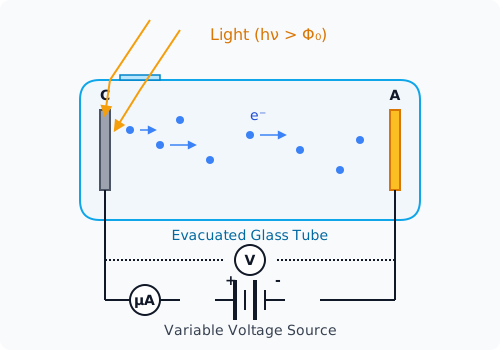
Work Function (\(\Phi_0\))
The minimum amount of energy required by an electron to just escape from the metal surface is called the work function of that metal. It is measured in electron-volts (\(\text{eV}\)). \[1\text{ eV} = 1.6 \times 10^{-19}\text{ J}\]
11.2 Experimental Study of Photoelectric Effect
Key observations from the experiments (Hertz, Hallwachs, and Lenard):
- Effect of Intensity of Light: The photoelectric current is directly proportional to the intensity of incident light, provided the frequency is above the threshold frequency.
- Effect of Potential: For a given frequency, if we apply a negative (retarding) potential to the collector plate, the photoelectric current decreases and finally becomes zero at a certain negative potential called the Stopping Potential (\(V_0\)). At stopping potential, even the most energetic photoelectrons are stopped: \[K_{max} = e V_0\]
- Effect of Frequency: There exists a certain minimum cut-off frequency \(\nu_0\), called the threshold frequency, below which no photoelectric emission occurs, regardless of the light’s intensity.
- Time Lag: The photoelectric emission is an instantaneous process (\(\sim 10^{-9}\text{ s}\)), even if the incident light is very dim.
11.3 Einstein’s Photoelectric Equation
The wave theory of light completely failed to explain the threshold frequency, instantaneous emission, and the independence of maximum kinetic energy from intensity.
Einstein (in 1905) proposed that electromagnetic radiation is quantized, consisting of discrete packets of energy called photons. Energy of a photon is: \[E = h\nu\] where \(h\) is Planck’s constant.
According to Einstein’s photoelectric equation, the energy \(h\nu\) of the incident photon is used in two parts:
- To overcome the surface barrier (Work function \(\Phi_0\) or \(W\)).
- To impart kinetic energy (\(K_{max}\)) to the emitted electron. \[h\nu = \Phi_0 + K_{max} \implies K_{max} = h\nu - \Phi_0\] Since \(\Phi_0 = h\nu_0\) (where \(\nu_0\) is threshold frequency), we can write: \[K_{max} = h(\nu - \nu_0)\] Also, using stopping potential \(eV_0 = K_{max}\): \[V_0 = \frac{h}{e}\nu - \frac{\Phi_0}{e}\] This is the equation of a straight line, verifying the particle nature of light.
11.4 Matter Waves (De-Broglie Hypothesis)
Louis de Broglie suggested that if radiation shows dual nature (wave and particle), then matter should also exhibit dual nature. A moving material particle should have wave-like properties associated with it.
The wavelength of the matter wave (de Broglie wavelength) associated with a particle of mass \(m\) moving with velocity \(v\) (and momentum \(p = mv\)) is: \[\lambda = \frac{h}{p} = \frac{h}{mv}\]
If an electron is accelerated from rest through a potential difference \(V\), its kinetic energy \(K = eV\). Its momentum \(p = \sqrt{2mK} = \sqrt{2meV}\). The de Broglie wavelength of an electron is: \[\lambda = \frac{h}{\sqrt{2meV}}\] Substituting the values of \(h, m,\) and \(e\): \[\lambda = \frac{1.227}{\sqrt{V}} \text{ nm}\]
This wave nature of electrons was experimentally verified by the macroscopic diffraction pattern observed in the Davisson-Germer experiment and is practically utilized in Electron Microscopes.
Competency-Based Questions
Multiple Choice Questions
Q1. [CBSE 2023] The work function of a metal is \(4.0\text{ eV}\). If light of wavelength \(200\text{ nm}\) falls on it, the maximum kinetic energy of the emitted photoelectrons will be approximately: (\(hc = 1240\text{ eV}\cdot\text{nm}\))
(A) \(6.2\text{ eV}\)
(B) \(2.2\text{ eV}\)
(C) \(10.2\text{ eV}\)
(D) \(0\text{ eV}\)
Answer:
Correct Option: (B)
Explanation: Energy of incident photon \(E = \frac{hc}{\lambda} = \frac{1240}{200} = 6.2\text{ eV}\).
\(K_{max} = E - \Phi_0 = 6.2 - 4.0 = 2.2\text{ eV}\).
Q2. [CBSE Sample Paper 2024] An electron, an alpha particle, and a proton have the same kinetic energy. Which one of these has the shortest de Broglie wavelength?
(A) Electron
(B) Alpha particle
(C) Proton
(D) All have the same wavelength
Answer:
Correct Option: (B)
Explanation: de Broglie wavelength \(\lambda = \frac{h}{\sqrt{2mK}}\). Since \(K\) is the same, \(\lambda \propto \frac{1}{\sqrt{m}}\). The alpha particle has the largest mass among the three, hence it will have the shortest wavelength.
Assertion-Reasoning Type Questions
Q3. [CBSE 2022] Assertion (A): The photoelectric current depends on the intensity of the incident light, provided the frequency is above the threshold frequency. Reason (R): Increasing the intensity of light means an increase in the number of photons hitting the metal surface per unit area per unit time, resulting in the emission of more photoelectrons.
Answer:
Correct Option: (A)
Explanation: Both assertion and reason are true, and the reason correctly explains the assertion. One photon interacts with one electron. More photons lead to more liberated electrons, increasing the current.
Case Study Based Question
Q4. Photocell Applications [CBSE Sample Paper 2024] A photocell is a technological application of the photoelectric effect. It converts light energy into electrical energy. Photocells are used in television cameras, burglar alarms, automatic doors, and street light control systems. When light falls on the cathode of the photocell, electrons are emitted, establishing a current in the external circuit. If the light is interrupted, the current stops, which can trigger a relay and an alarm.
(i) A burglar alarm using a photocell will trigger when:
(A) Red light from a laser falls directly on it
(B) An intruder blocks the invisible infrared or UV light beam falling on the photocell
(C) The ambient room temperature drops
(D) The room lights are turned on
Answer:
Correct Option: (B) The continuous light beam holds the switch in an open state via the photoelectric current. Breaking the beam stops the current, closing the secondary alarm circuit via a relay.
(ii) Einstein’s explanation of the photoelectric effect assumes that:
(A) Light is a continuous wave
(B) Light consists of particle-like packets of energy called photons
(C) Metals contain positive electrons
(D) The speed of light is infinite
Answer:
Correct Option: (B) The particle-like nature (quantization of electromagnetic radiation) is the foundation of Einstein’s explanation.