Chapter 12: Atoms
12.1 Alpha-particle Scattering Experiment
Ernest Rutherford’s associates (Geiger and Marsden) directed a beam of \(\alpha\)-particles towards a thin gold foil. Observations:
- Most \(\alpha\)-particles passed through the foil undeflected.
- A small fraction were deflected by small angles.
- A very small number (\(\sim 1 \text{ in } 8000\)) bounced back (deflected by \(180^\circ\)).
Conclusions (Rutherford’s Model):
- Most of the space inside an atom is empty.
- The entire positive charge and almost all the mass of the atom are concentrated in a very small central core called the nucleus.
- Electrons revolve around the nucleus in circular orbits.
12.2 Bohr Model of Hydrogen Atom
Rutherford’s model could not explain the stability of the atom and the discrete line spectra observed for elements. Niels Bohr modified the model using quantum concepts.
Bohr’s Postulates:
- Stationary Orbits: Electrons revolve only in certain allowed circular orbits without radiating energy.
- Quantization of Angular Momentum: The angular momentum of an electron in a stationary orbit is an integral multiple of \(h/(2\pi)\). \[mvr = \frac{nh}{2\pi}\] where \(n = 1, 2, 3 \dots\) is the principal quantum number.
- Frequency Postulate: An electron radiates energy when it jumps from a higher energy state (\(E_i\)) to a lower energy state (\(E_f\)). The frequency \(\nu\) of the emitted photon is given by: \[h\nu = E_i - E_f\]
Radius, Velocity, and Energy
For the hydrogen atom (\(Z=1\)):
- Radius of \(n^{\text{th}}\) orbit: \(r_n = \frac{n^2 h^2 \varepsilon_0}{\pi m e^2}\). \(r_n \propto n^2\). For \(n=1\), \(r_1 \approx 0.53\text{ }\mathring{A}\) (Bohr radius).
- Velocity in \(n^{\text{th}}\) orbit: \(v_n = \frac{e^2}{2 \varepsilon_0 n h}\). \(v_n \propto 1/n\).
- Total Energy in \(n^{\text{th}}\) orbit: The energy is quantized and negative, indicating a bound state. \[E_n = -\frac{me^4}{8 \varepsilon_0^2 h^2 n^2} = \frac{-13.6}{n^2} \text{ eV}\]
12.3 Hydrogen Line Spectra
When an electron jumps from a higher initial energy state (\(n_i\)) to a lower final state (\(n_f\)), a photon of wavelength \(\lambda\) is emitted: \[\frac{1}{\lambda} = R \left(\frac{1}{n_f^2} - \frac{1}{n_i^2}\right)\] where \(R = 1.097 \times 10^7 \text{ m}^{-1}\) is the Rydberg constant.
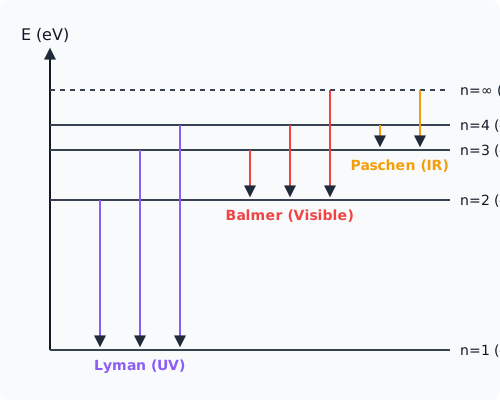
The spectral series are defined by the final state \(n_f\):
- Lyman Series: \(n_f = 1\) (Ultraviolet region)
- Balmer Series: \(n_f = 2\) (Visible region)
- Paschen Series: \(n_f = 3\) (Infrared region)
- Brackett Series: \(n_f = 4\) (Infrared region)
- Pfund Series: \(n_f = 5\) (Far Infrared region)
Competency-Based Questions
Multiple Choice Questions
Q1. [CBSE 2025 Sample Paper] The ratio of the energies of the hydrogen atom in its first to second excited state is:
(A) \(1/4\)
(B) \(4/9\)
(C) \(9/4\)
(D) \(4\)
Answer:
Correct Option: (C)
Explanation: The energy of the \(n\)-th state is \(E_n = \frac{-13.6}{n^2}\).
First excited state corresponds to \(n=2\), so \(E_2 = -13.6/4 \text{ eV}\).
Second excited state corresponds to \(n=3\), so \(E_3 = -13.6/9 \text{ eV}\).
Ratio \(\frac{E_2}{E_3} = \frac{-13.6/4}{-13.6/9} = \frac{9}{4}\).
Q2. [CBSE 2021] Which of the following series of hydrogen spectrum lies in the visible region?
(A) Lyman series
(B) Balmer series
(C) Paschen series
(D) Bracket series
Answer:
Correct Option: (B)
Explanation: The Balmer series is produced when an electron transitions to the \(n=2\) state. The emitted photons have wavelengths between \(400\text{ nm}\) and \(700\text{ nm}\), which falls perfectly in the visible light spectrum.
Assertion-Reasoning Type Questions
Q3. [CBSE 2024] Assertion (A): Electrons in the atom are held due to the Coulomb force of attraction between the nucleus and the electrons. Reason (R): The atom is stable only because the centripetal force required for revolution is provided by the Coulomb force.
Answer:
Correct Option: (A)
Explanation: Both assertion and reason are dynamically true, and the reason is the correct explanation of the assertion in the context of Rutherford and Bohr’s planetary model. The electrical attraction \(1/(4\pi\varepsilon_0)e^2/r^2\) provides the centripetal force \(mv^2/r\).
Case Study Based Question
Q4. Spectral Lines Analysis [CBSE 2023] A team of astronomers is analyzing the light coming from a distant molecular cloud to understand its composition. They observe discrete emission lines in the visible part of the spectrum that perfectly match the Balmer series of Hydrogen.
(i) What does this observation directly confirm about the molecular cloud?
(A) The cloud contains a significant amount of Hydrogen gas
(B) The cloud contains ionized Helium
(C) The cloud is moving towards the observer
(D) The cloud is primarily composed of dark matter
Answer:
Correct Option: (A) The unique spectral fingerprints (discrete line spectra) identify elements. The presence of Balmer series confirms Hydrogen.
(ii) If an electron in a hydrogen atom transitions from \(n=4\) to \(n=2\), what is the approximate energy of the emitted photon?
(A) \(3.4\text{ eV}\)
(B) \(2.55\text{ eV}\)
(C) \(1.89\text{ eV}\)
(D) \(0.85\text{ eV}\)
Answer:
Correct Option: (B) \(E_4 = -0.85\text{ eV}\), \(E_2 = -3.40\text{ eV}\). Energy of photon \(\Delta E = E_4 - E_2 = -0.85 - (-3.40) = 2.55\text{ eV}\).