Chapter 13: Nuclei
13.1 Composition and Size of Nucleus
The nucleus of an atom consists of protons and neutrons, collectively known as nucleons.
- Atomic Number (\(Z\)): Number of protons.
- Mass Number (\(A\)): Total number of protons and neutrons. \(A = Z + N\).
- Isotopes: Same \(Z\), different \(A\).
- Isobars: Same \(A\), different \(Z\).
- Isotones: Same number of neutrons (\(N = A - Z\)).
Radius of a Nucleus: Experimental results show that the volume of a nucleus is proportional to its mass number \(A\). Therefore, the radius \(R\) is: \[R = R_0 A^{1/3}\] where \(R_0 \approx 1.2 \times 10^{-15}\text{ m} = 1.2\text{ fm}\). This implies that nuclear density is constant and independent of the mass number \(A\), and is extremely high (\(\approx 2.3 \times 10^{17}\text{ kg/m}^3\)).
13.2 Mass-Energy Relation and Mass Defect
Einstein showed that mass and energy are inter-convertible: \[E = mc^2\] Because nuclear masses are very small, they are measured in atomic mass units (\(\text{u}\)), where \(1\text{ u} = \frac{1}{12}\) th of the mass of a Carbon-12 atom. \(1\text{ u} \approx 931.5 \text{ MeV/c}^2\).
Mass Defect (\(\Delta m\)): The mass of a stable nucleus is always less than the sum of the masses of its constituent nucleons. This difference is called mass defect. \[\Delta m = [Z m_p + (A-Z) m_n] - M\] where \(m_p\) is proton mass, \(m_n\) is neutron mass, and \(M\) is the mass of the nucleus.
13.3 Binding Energy
The binding energy (\(BE\)) of a nucleus is the energy required to break the nucleus into its constituent nucleons. It is the energy equivalent of the mass defect. \[BE = \Delta m \times c^2 \quad \text{or} \quad BE \text{ (in MeV)} = \Delta m \text{ (in u)} \times 931.5\]
Binding Energy Per Nucleon (\(E_{bn}\))
It determines the stability of a nucleus. The higher the binding energy per nucleon, the more stable the nucleus. \[E_{bn} = \frac{BE}{A}\]
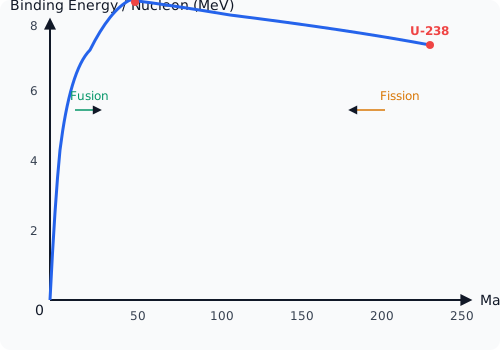
Key features of the curve:
- Average \(E_{bn} \approx 8\text{ MeV}\) for most nuclei (\(30 < A < 170\)).
- Maximum binding energy is for Iron (\(^{56}\text{Fe}\)), which is \(8.8\text{ MeV/nucleon}\).
- Lighter nuclei (\(A < 30\)) and heavier nuclei (\(A > 170\)) have lower binding energy per nucleon, making them relatively less stable.
13.4 Nuclear Force
Nuclear force is the strong attractive force between nucleons in a nucleus. Properties:
- Strongest force in nature, much stronger than the Coulomb force.
- Short-range force: It operates only over a very short distance (\(\approx 2-3\text{ fm}\)). It becomes abruptly zero at larger distances.
- It is strictly charge-independent (\(n-n\), \(p-p\), and \(n-p\) forces are approximately the same).
- It is repulsive at extremely close distances (less than \(0.7\text{ fm}\)), keeping the nucleus from collapsing.
13.5 Nuclear Fission and Fusion
Since mid-weight nuclei (\(A \approx 50-80\)) are most stable, reactions that move nuclei towards this region release large amounts of energy.
- Nuclear Fission: A heavy nucleus (e.g., Uranium-235) splits into two lighter, more stable nuclei when bombarded with slow neutrons, releasing a massive amount of energy (due to increased \(E_{bn}\)).
- Nuclear Fusion: Two light nuclei (e.g., Hydrogen isotopes) combine to form a heavier nucleus. This also releases a huge amount of energy. Fusion requires extremely high temperatures and pressures to overcome electrostatic repulsion, which is why it occurs naturally in the cores of stars, including the Sun.
Competency-Based Questions
Multiple Choice Questions
Q1. [CBSE 2023] The nuclear radius of a nucleus with mass number \(27\) is \(3.6\text{ fm}\). The nuclear radius of a nucleus with mass number \(64\) is:
(A) \(4.8\text{ fm}\)
(B) \(5.4\text{ fm}\)
(C) \(6.4\text{ fm}\)
(D) \(3.2\text{ fm}\)
Answer:
Correct Option: (A)
Explanation: Nuclear radius \(R \propto A^{1/3}\).
Therefore, \(\frac{R_2}{R_1} = \left(\frac{A_2}{A_1}\right)^{1/3}\).
\(\frac{R_2}{3.6} = \left(\frac{64}{27}\right)^{1/3} = \frac{4}{3}\).
\(R_2 = 3.6 \times \frac{4}{3} = 4.8\text{ fm}\).
Q2. [CBSE Sample Paper 2024] Which of the following statements about nuclear forces is NOT true?
(A) They are charge-independent.
(B) They are the strongest forces in nature.
(C) They are long-range forces like gravitational forces.
(D) They become repulsive at extremely small distances.
Answer:
Correct Option: (C)
Explanation: Nuclear forces are exclusively short-range forces and act only within the confines of the nucleus (\(\sim 10^{-15}\text{ m}\)).
Assertion-Reasoning Type Questions
Q3. [CBSE 2022] Assertion (A): Energy is released in nuclear fission. Reason (R): The total binding energy of the fission fragments is larger than the total binding energy of the parent nucleus.
Answer:
Correct Option: (A)
Explanation: Both assertion and reason are correct and logically linked. Fission products lie closer to the peak of the binding energy curve (Iron-56), meaning they are more tightly bound. The transition from a less-tightly bound state to a more-tightly bound state releases the excess energy.
Case Study Based Question
Q4. Nuclear Reactor [CBSE 2025 Sample Paper] In a nuclear reactor, the energy released in nuclear fission is controlled and converted into electrical energy. Slow neutrons are highly effective in causing fission of U-235. During fission, fast neutrons are produced. These fast neutrons must be slowed down so they can cause further fissions, maintaining a controlled chain reaction. This is achieved by using a “moderator.” Furthermore, “control rods” are used to absorb excess neutrons to control the reaction rate.
(i) Which material is commonly used as a moderator in a nuclear reactor?
(A) Cadmium
(B) Heavy water (\(D_2O\))
(C) Uranium-238
(D) Boron
Answer:
Correct Option: (B) Light nuclei substances like heavy water and graphite are used as moderators because they efficiently slow down fast neutrons via elastic collisions without absorbing them.
(ii) Why are control rods made of Cadmium or Boron?
(A) Because they multiply the neutrons
(B) Because they slow down the neutrons
(C) Because they are excellent neutron absorbers
(D) Because they act as a coolant
Answer:
Correct Option: (C) Cadmium and Boron have a very high cross-section for neutron absorption, thus they remove excess neutrons from the reactor core, preventing the chain reaction from accelerating out of control.